



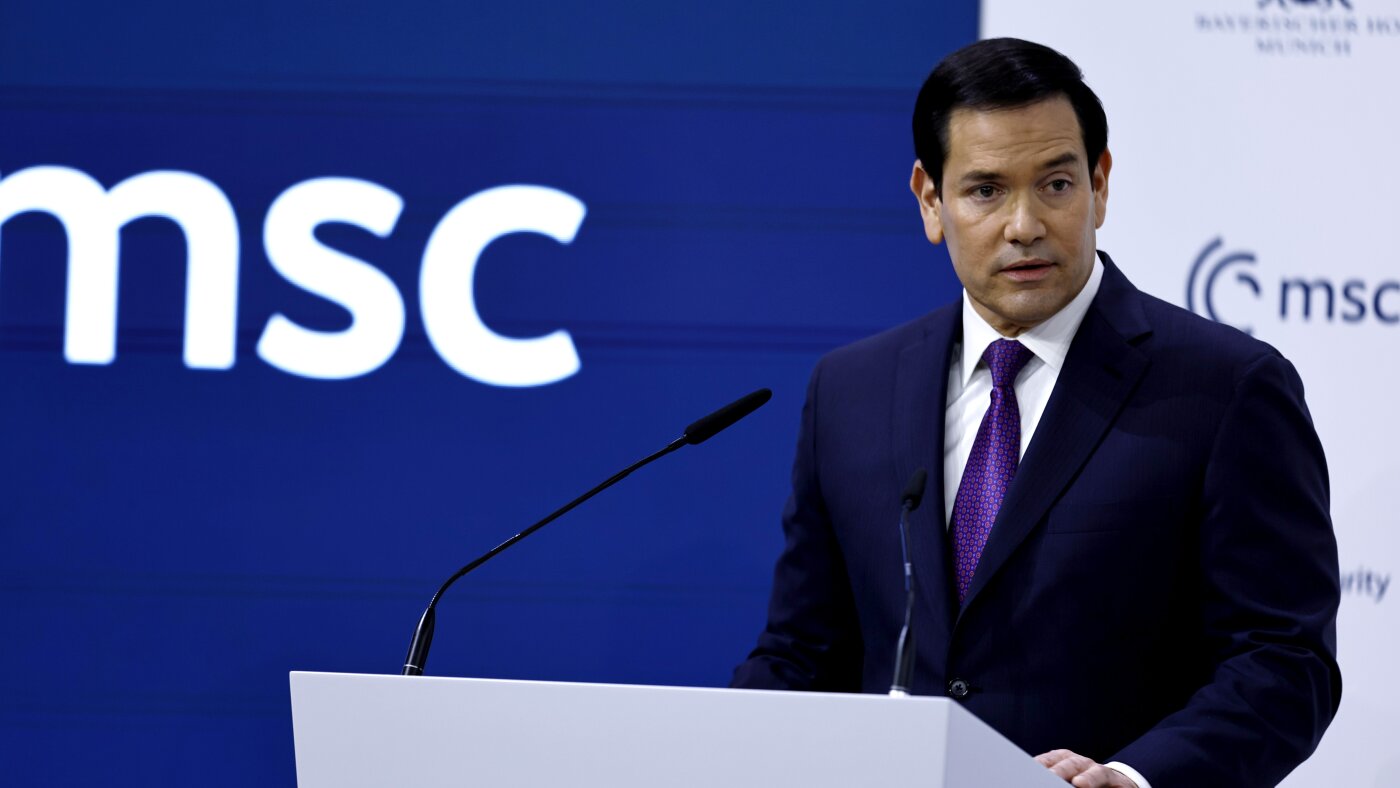

U.S. Secretary of State Marco Rubio delivers a key note speech at the 62nd Munich Security Conference, on Feb. 14 in Munich, Germany.
Johannes Simon/Getty Images
hide caption
toggle caption
Johannes Simon/Getty Images
MUNICH — After last year’s lecture on free speech and democracy from Vice President Vance that left many European leaders shocked, the expectations for a follow-up by Secretary of State Marco Rubio at this year’s Munich Security Conference couldn’t have been lower.
And with that bar set about as low as it can be, Rubio cleared it — barely. A year ago, Vance attacked Europe for allowing what he saw as out-of-control migration.
But Rubio took a different approach: He said that immigration had become a challenge in the U.S. as well. And he said that together, the U.S. and Europe in the postwar era had “a dangerous delusion” that they had entered “the end of history” and that “every nation would now be a liberal democracy, that the ties formed by trade and by commerce alone would now replace nationhood.” But the end result was that “an unprecedented wave of mass migration that threatens the cohesion of our societies, the continuity of our culture, and the future of our people.”
Throughout his speech, Rubio drew Europeans closer to the destiny of the United States, outlining the contributions from European countries to the construction of the New World. “Our frontiers were shaped by Scots-Irish, that proud Hardy clan from the hills of Ulster,” Rubio said. “That gave us Davy Crockett and Mark Twain. And Teddy Roosevelt and Neil Armstrong. Our great Midwestern heartland was built by German farmers and craftsmen who transformed empty plains into a global agricultural powerhouse.”

Rubio also cited the contributions of the Italians, French and Spanish to the formation of the United States, but he neglected to mention the Native Americans who many of these groups left devastated. He didn’t mention how these groups exploited African slaves, or the Chinese who helped build the railway in the American West, or the contributions of so many other cultures who have made the United States what it is today.

And when Rubio was finished, the European leaders assembled inside the Hotel Bayerischer Hof rewarded him with a standing ovation. Conference organizer Wolfgang Ischinger, a former German ambassador to the U.S., took to the stage and said Europe was “breathing a sigh of relief,” referring to the leaders present, whose countries have long depended on American security guarantees and trade, and who were painfully accepting they were being pulled away.
One official not impressed with Rubio’s cherry-picked history of the early United States was European Union foreign policy chief Kaja Kallas, who wore a look of horror and was one of the few people in the room who did not immediately stand during the applause.

European Union High Representative for Foreign Affairs and Security Policy Kaja Kallas gives a speech at the 62nd Munich Security Conference on Feb. 15.
Thomas Kienzle/AFP via Getty Images
hide caption
toggle caption
Thomas Kienzle/AFP via Getty Images
“Contrary to what some may say, woke, decadent Europe is not facing civilizational erasure,” she said on stage on the final day of the conference.
Kallas was not alone in her reluctance to be reassured by a member of the Trump administration. One of the most consequential speeches of the three-day conference came from a leader who typically is not known for rousing, unifying oratory: German Chancellor Friedrich Merz.
Merz’s no-nonsense speech, delivered on Friday, the opening day of the conference, noted that the theme of this year’s conference, titled “Under Destruction,” was a grim outlook on an international rules-based order.

German Chancellor Friedrich Merz speaks with Wolfgang Ischinger (not pictured), chairman of the Munich Security Conference, after delivering his speech at the conference on Feb. 13.
Johannes Simon/Getty Images
hide caption
toggle caption
Johannes Simon/Getty Images
“But I’m afraid that we have to put it in even harsher terms: This order, as flawed as it has been in its heyday, no longer exists,” he said.
Merz blasted the bullying nature of “big power politics” waged by the U.S. under President Trump, China and Russia. “Great power politics turns away from a world in which increasing connectivity translates into the rule of law and peaceful relations between states,” said Merz. “Natural resources, technologies and supply chains are becoming bargaining tools in the zero-sum game of the major powers. This is a dangerous game.”
Merz told conference attendees that Germany and the rest of Europe had learned the lessons from World War II about “big power” governance and he urged European countries to unite their resources to resist these big powers, and to build a new European economy that will rival these big powers but maintain democratic values.
“Russia’s GDP is currently about 2 trillion euros, but that of the European Union is almost 10 times as high,” said Merz, “but still Europe is not 10 times as strong. Our military, political, economic and technological potential is huge, but we haven’t tapped into this potential for a very long time, so the most important thing is to turn the switch in our minds now.”
Merz acknowledged that the current geopolitical climate has forced Germany to implement changes to how it funds its military so that it is able to operate at “full speed,” but he said harnessing that pressure to create something new and good is now all of Europe’s responsibility.
And while European leaders may give visiting Trump administration officials standing ovations when they hear a rekindling of hope for the trans-Atlantic relationship, the tenor of this year’s Munich Security Conference showed that these displays of appreciation are just that.
Europe is moving on.

