




Protesters demonstrate against federal immigration actions at an “ICE Out of Everywhere” rally in front of City Hall in downtown Los Angeles on Jan. 31.
Apu Gomes/AFP via Getty Images
hide caption
toggle caption
Apu Gomes/AFP via Getty Images
As the United States heads toward the midterm elections, there are growing concerns among some political scientists that the country has moved even further along the path to some form of autocracy.

Staffan I. Lindberg, the director of Sweden’s V-Dem Institute, which monitors democracy across the globe, says the U.S. has already crossed the threshold and become an “electoral autocracy.”
Steven Levitsky, a professor of government at Harvard University and co-author of How Democracies Die, agrees.
“I would argue that the United States in 2025-26 has slid into a mild form of competitive authoritarianism,” Levitsky said. “I think it’s reversible, but this is authoritarianism.”
Under competitive authoritarianism, countries still hold elections, but the ruling party uses various tactics — attacking the press, disenfranchising voters, weaponizing the justice system and threatening critics — to tilt the electoral playing field in its favor.
Levitsky cited what he considers two strikingly autocratic moments that occurred in September. First, the Trump administration threatened ABC’s parent company, Disney, following Jimmy Kimmel’s comments on the killing of Charlie Kirk.
“We can do this the easy way or the hard way,” Brendan Carr, the chairman of the Federal Communications Commission, warned.
A week later, President Trump proposed that U.S. generals use American cities as training grounds for their troops.
“We’re under invasion from within,” Trump said to a gathering of military brass in Quantico, Virginia. “No different than a foreign enemy, but more difficult in many ways because they don’t wear uniforms.”

Protesters throw trash and objects as they clash with federal agents and police during a “National Shutdown” protest against Immigration and Customs Enforcement in Los Angeles on Jan. 30, following the shooting deaths of two U.S. citizens by federal agents in Minneapolis.
Patrick T. Fallon/AFP
hide caption
toggle caption
Patrick T. Fallon/AFP
Levitsky said this is the kind of language dictators in South America used in the 1970s — leaders like Augusto Pinochet in Chile.
A smaller number of scholars reject the portrayal of Trump as a would-be autocrat. They say he is expanding executive power to address the excesses of his predecessor, former President Joe Biden.
Jonathan Turley, a professor at George Washington University Law School, says Trump is pressuring news organizations and universities to address problems with liberal bias.
“There are legitimate objections that have been raised by the Trump administration,” said Turley, the author of Rage and the Republic. “That does not justify some of the means, but there is a long-standing need for a debate within these institutions.”
Other political scientists say the U.S. system of government is battered but still democratic. Kurt Weyland, who researches democracy and authoritarianism at the University of Texas at Austin, says he’s increasingly confident that the U.S. can withstand Trump’s sweeping attempt to expand executive power.
Weyland said that for the first months of his second term, Trump was like a “steamroller” and faced little containment or opposition. But Weyland, who wrote Democracy’s Resilience to Populism’s Threat: Countering Global Alarmism, says that has changed.
For instance, Kimmel was yanked off the air but soon returned and continues to routinely mock Trump. Weyland also said the president’s attempt to tilt the electoral playing field through mass redistricting hasn’t worked out as he might have hoped.
“If the guy had succeeded in seriously skewing [future] elections in the House, that would’ve gone to the core of democracy,” said Weyland, “but he didn’t. He got barely anything.”
Weyland also said federal agents shooting two U.S. citizens in Minneapolis last month was disastrous for the president. Border czar Tom Homan said last week that the immigration enforcement surge in Minnesota is ending. Weyland thinks the public blowback to the killings limits Trump’s ability to deploy such aggressive tactics going forward.

Demonstrators spell out an SOS signal of distress on a frozen lake in Minneapolis, in the aftermath of the shooting deaths of Renee Macklin Good and Alex Pretti by federal immigration agents.
John Moore/Getty Images
hide caption
toggle caption
John Moore/Getty Images
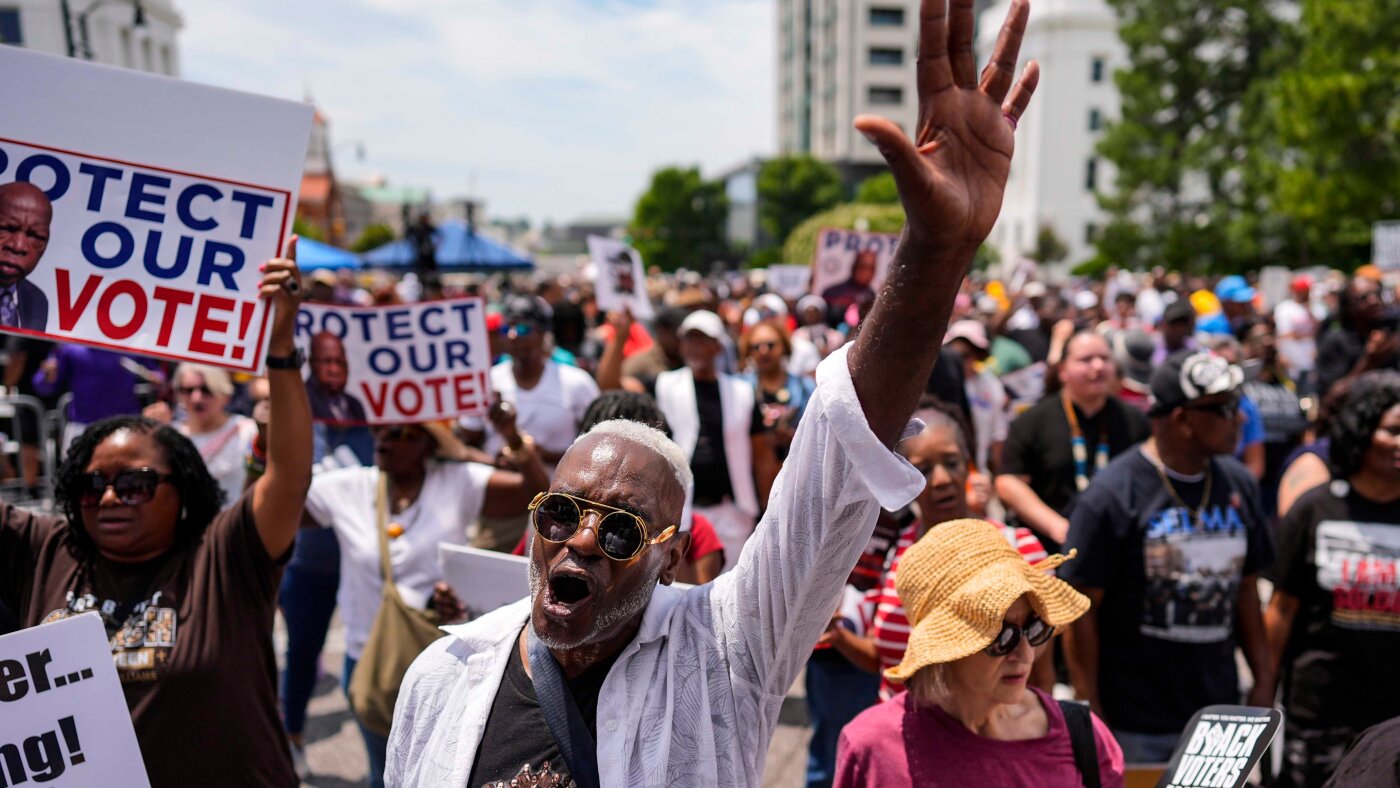
The next big test for American democracy could come in November’s midterms. The Trump administration is suing states to hand over voter data, which worries Kim Scheppele, a Princeton University sociologist who has studied the authoritarian tactics of Hungarian Prime Minister Viktor Orbán.
In 2014, Orbán’s government messaged Hungarian voters living in the United Kingdom to go to one polling place and then switched to a different location on Election Day.
“They disenfranchised almost all the Hungarians in the U.K., most of whom were oppositional to Orbán,” says Scheppele.
This month, Steve Bannon, a close Trump ally, proposed that the administration deploy Immigration and Customs Enforcement (ICE) to polling places to root out undocumented migrants trying to vote — which is statistically rare.
White House press secretary Karoline Leavitt said she’d never heard the president discuss such a plan — and federal law prohibits it.
But Brendan Nyhan, a professor of government at Dartmouth College, worries that such a move would drive down participation by people of color and naturalized citizens who fear harassment by ICE. If ICE were deployed, Nyhan hopes it would spark even more people to vote.
“But even contemplating that kind of interference is, I think, a really substantial threat,” said Nyhan. “The way Election Day works in this country, there are no do-overs.”

