


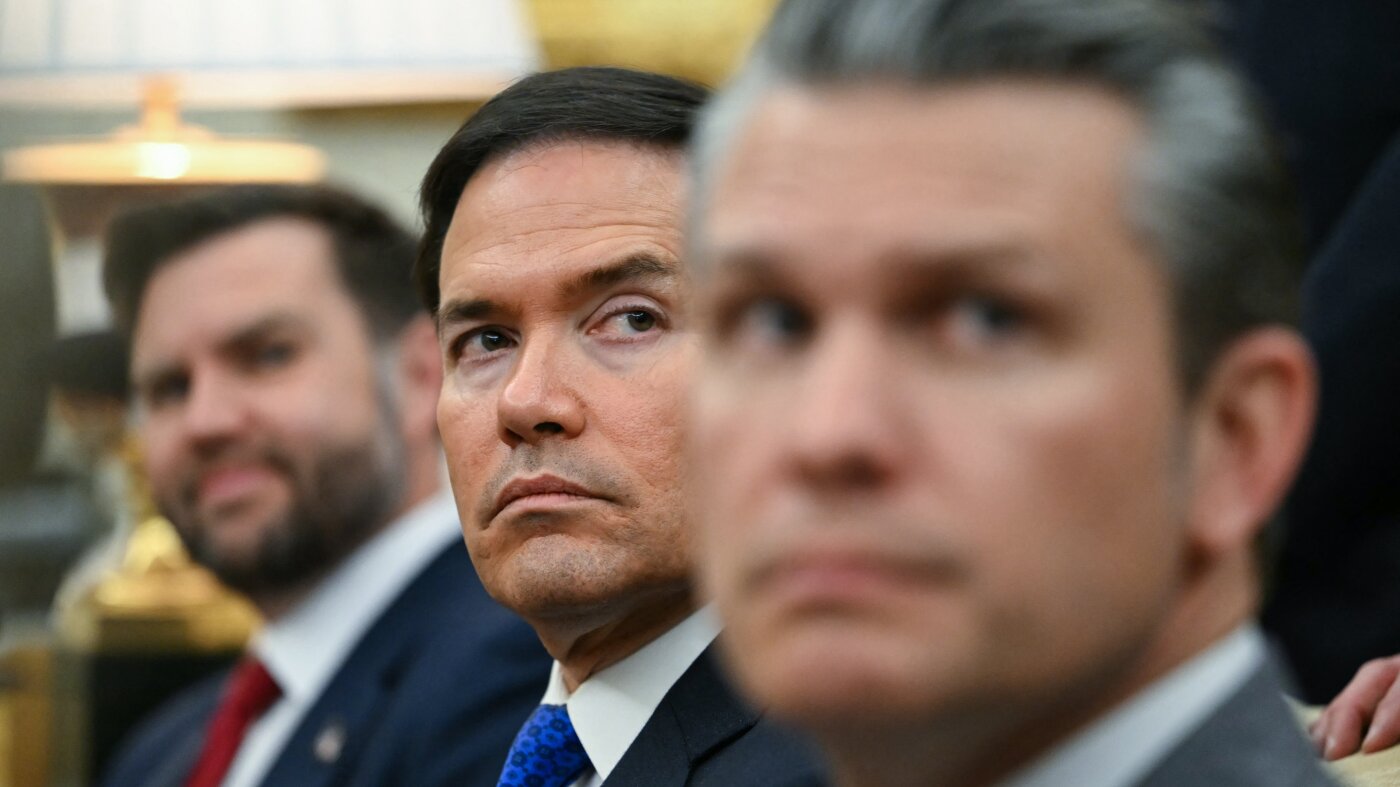

Vice President Vance, Secretary of State Marco Rubio and Defense Secretary Pete Hegseth look on as President Trump meets with German Chancellor Friedrich Merz in the White House on March 3.
Andrew Caballero-Reynolds/AFP via Getty Images
hide caption
toggle caption
Andrew Caballero-Reynolds/AFP via Getty Images
Stay up to date with our Politics newsletter, sent weekly.
The Trump administration says it is “laser focused” and mission driven in its attacks on Iran, but messaging from President Trump, Secretary of State Marco Rubio and Defense Secretary Pete Hegseth has been varied. The wide range of motivations they have cited for why they attacked Iran now are sometimes at odds with each other and far from precise.
Here’s a look at what the administration says about why it launched strikes on Iran and where the conflict goes from here:
“The United States of America will come to their rescue”
“If Iran sho[o]ts and violently kills peaceful protesters, which is their custom, the United States of America will come to their rescue. We are locked and loaded and ready to go.” — President Trump in a Jan. 2 Truth Social post
In early January, Trump threatened taking military action if Iran continued to kill demonstrators during historic protests against the regime. A couple of weeks later, Trump followed up, urging demonstrators to “keep protesting” and adding, “Help is on its way.”
But the regime continued to kill protesters in mass numbers, which many international observers saw as crossing Trump’s red line and adding pressure on him to strike.

Days after launching initial strikes on Feb. 28, Trump again pointed to the number of protesters killed as rationale for going to war. But when pressed to clarify the imminent threats for taking action, the White House has not mentioned protesters among the top reasons for striking when it did.
“Something had to be done”
“Something had to be done, and it’s been 47 years. They’ve been killing people all over the world for a long time. They were the kings and fathers of the roadside bomb.” — President Trump during a bilateral meeting with German Chancellor Friedrich Merz on March 3
When announcing the beginning of strikes, Trump vowed that Iran’s network of proxy groups that fight across the region must be stopped. Iran has long supported the loose group of armed forces known as the Axis of Resistance. Iran has provided military and financial support to Hamas, Hezbollah and the Houthis.
Hezbollah has already hit back, striking Israeli forces. That led to Israel sending troops across the border while bombing the Lebanese capital.
Hezbollah and Hamas have been weakened over the past year due to fighting with Israel, but the attacks and the killing of Iran’s supreme leader have the potential to inspire more activity by the groups.
“You would have had a nuclear war” — or would we?
“If we don’t stop them or if we didn’t stop them or if we didn’t start — they’ve been decimated — but if we didn’t do what we’re doing right now, you would have had a nuclear war and they would have taken out many countries.” — President Trump during a bilateral meeting with German Chancellor Friedrich Merz on March 3
Trump has claimed that the U.S. strikes in June on three of Iran’s key nuclear sites, including one called Fordo, built deep inside a mountain, rendered them “completely and totally obliterated.”
Days later in June, a U.S. official who was not authorized to speak publicly said intelligence assessments showed that the strikes set Iran’s nuclear enrichment program back merely “a few months.”
On Wednesday, Trump again said the program was obliterated but immediately followed up by saying that Iran would have had a nuclear weapon in two weeks if the U.S. hadn’t struck.
“Missiles capable of reaching our beautiful America”
“The regime already had missiles capable of hitting Europe and our bases, both local and overseas, and would soon have had missiles capable of reaching our beautiful America.” — President Trump defending the U.S. military operation on March 2 before awarding the Medal of Honor to three soldiers
One of the more consistent rationales the White House has given for launching strikes is that Iran was threatening U.S. forces and allies in the region with its growing ballistic missile program. But Trump took it a step further by saying that Tehran would “soon” be able to hit targets in the U.S. with ballistic missiles.
But that claim is not backed up by any public U.S. intelligence reports. The Defense Intelligence Agency reported last spring that Iran would not be able to develop a long-range missile by 2035.

Defense Secretary Pete Hegseth also charged Tehran with working to further fortify its nuclear capabilities against a strike. He said Iran was building missiles and drones to create a “conventional shield” for its nuclear weapon ambitions.
“We knew that there was going to be an Israeli action”
“The president made the very wise decision. We knew that there was going to be an Israeli action. We knew that that would precipitate an attack against American forces, and we knew that if we didn’t preemptively go after them before they launched those attacks, we would suffer higher casualties.” — Secretary of State Marco Rubio to reporters on Capitol Hill on March 2
Those comments led to widespread criticism, including from supporters on the right, that Trump was allowing Israel to lead him into war.
The White House quickly sought to regain the narrative. A day later, Trump rejected that characterization and argued that the U.S. forced Israel’s hand.
But on Wednesday, White House press secretary Karoline Leavitt said a phone call between Trump and Israeli Prime Minister Benjamin Netanyahu before they launched the war may have impacted the timing of the attack, but that prior to that phone call, Trump “had a good feeling that the Iranian regime was going to strike the United States’ assets and our personnel in the region.”
“UNCONDITIONAL SURRENDER!”
“There will be no deal with Iran except UNCONDITIONAL SURRENDER! After that, and the selection of a GREAT & ACCEPTABLE Leader(s), we, and many of our wonderful and very brave allies and partners, will work tirelessly to bring Iran back from the brink of destruction, making it economically bigger, better, and stronger than ever before.” — President Trump in a March 6 Truth Social post
“This is not a so-called regime change war, but the regime sure did change and the world is better off for it.” — Defense Secretary Pete Hegseth at a March 2 Pentagon press briefing
Trump says combat will continue until U.S. objectives are met, but he and his aides have given confusing explanations about the future of Iranian leadership.
When announcing the strikes, Trump said the U.S. military would destroy Iran’s ballistic missile program, prevent the regime from obtaining a nuclear weapon and stop support of military proxy networks.
But he also strongly implied seeking regime change when he called on the Iranian people “to be bold, be heroic and take back your country.”

But Hegseth and the administration have since distanced themselves from those comments. Hegseth told reporters: “This is not a so-called regime change war, but the regime sure did change and the world is better off for it.” And Leavitt, the press secretary, on Wednesday did not list regime change as one of Trump’s objectives for ending the war.
“We thought we had a deal”
“We thought we had a deal, but then they backed out and then they came back and we thought we had a deal and they backed out. I said, ‘You can’t deal with these people. You got to do it the right way.'” — President Trump defending the U.S. military operation on March 2 before awarding the Medal of Honor to three soldiers
Two Fridays ago, Trump expressed frustration over nuclear negotiations with Tehran but also indicated he was willing to give negotiations more time. Hours later, the U.S. launched airstrikes on Iran.
Senior administration officials have repeatedly said that the negotiations with Iran were not making headway and that Iran seemed to be slow-walking the process while continuing its nuclear ambitions.
Omani Foreign Minister Badr al-Busaidi, who had been helping mediate talks, said negotiations were ongoing and making progress. Writing on social media, he said he was dismayed by the strikes and accused the U.S. of undermining serious negotiations.

