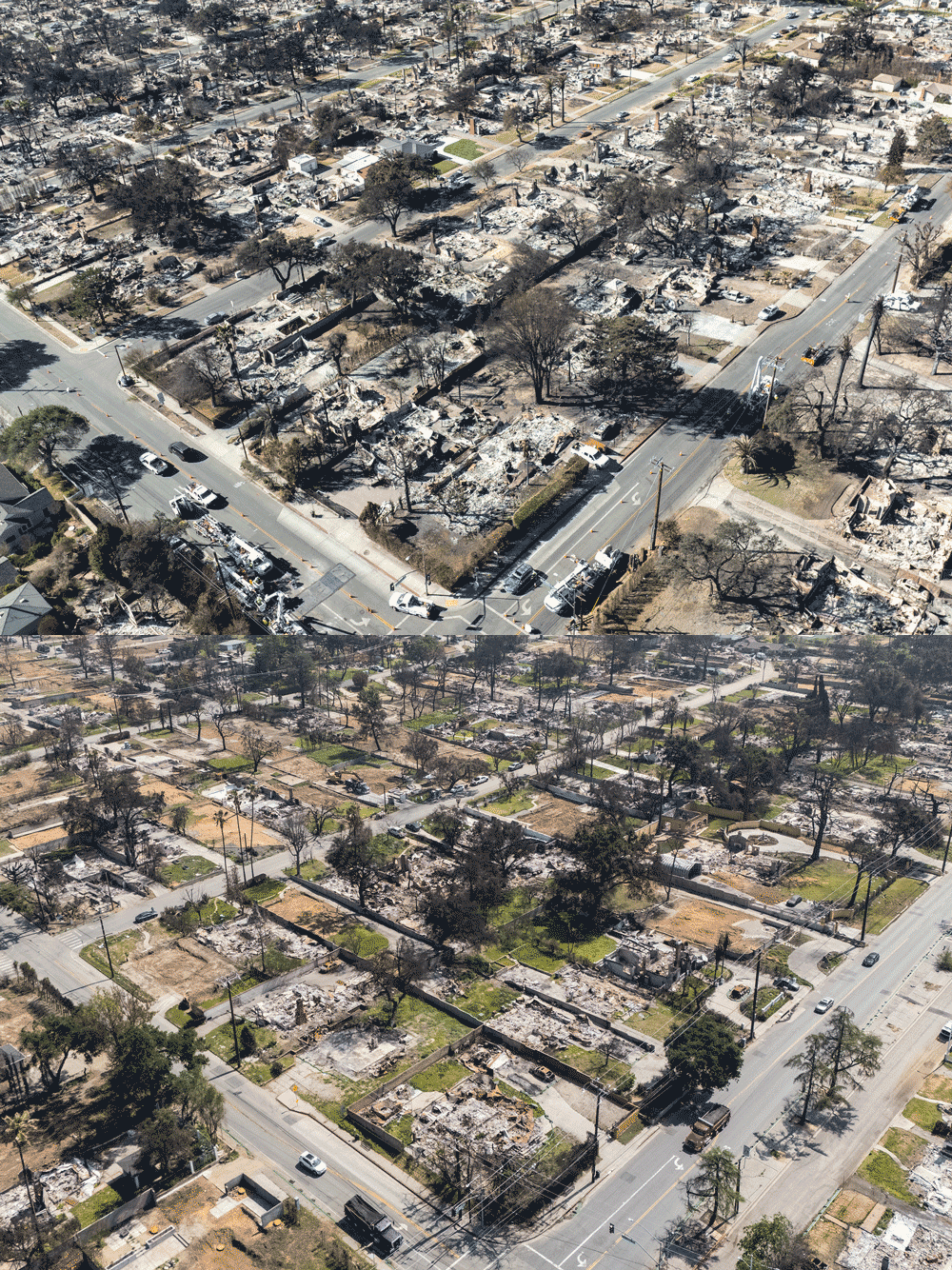

A prominent civil rights attorney who represented the families of George Floyd, Breonna Taylor and Trayvon Martin announced he’s gathering evidence for a possible federal discrimination lawsuit against Los Angeles County over its response to the Eaton fire.
Attorney Ben Crump has joined the growing ranks of officials and community leaders concerned that the county’s response in Altadena’s historically Black neighborhoods during the Eaton fire was lacking compared with that for the whiter communities threatened by the blaze.
The announcement comes weeks after the California attorney general opened a civil rights probe into the county’s fire preparations and response, focusing on potential disparities in historically Black west Altadena. That section of town received evacuation alerts hours after flames threatened the area, and much later than wealthier, whiter areas of the unincorporated town.
Crump said he suspected the investigation would find racism at the root of the botched response to the fire, which decimated west Altadena. He did not specify when he planned to sue.
“We are fighting to not have Altadena become California’s Katrina, where you have all those Black citizens and their generational wealth that they were passing on to their children just lost and never regained,” Crump said at a news conference in Los Angeles on Thursday.
Crump is known for representing relatives of victims of high-profile police brutality cases. He is also playing a role in some of the major non-police litigation underway in the county, including representing victims of sex abuse in the county’s juvenile halls and roughly 600 victims of the Eaton fire.
Crump said Thursday he was teaming up with Carl Douglas, a civil rights attorney known for representing O. J. Simpson during his 1995 murder trial, to explore a lawsuit against the county.
“If the facts show there was no discrimination, so be it,” Douglas said. “But if the facts show that decisions were made based on the racial composition of the community, we will seek accountability.”
Altadena evacuees La Toya Andrews, left, and Nancy Ferdinand gather at a donation center set up at First AME Zion Church in Pasadena to help residents affected by the Eaton fire in January 2025.
(Jason Armond / Los Angeles Times)
A spokesperson for L.A. County said in a statement none of the reviews of the fire response has found “any discriminatory or structural bias in the County’s response.”
“We believe any new inquiry will find that emergency responders did the best they could under unprecedented and extremely destructive fire conditions with hurricane force winds and the inability to perform aerial reconnaissance, as they fought to save lives, homes, and businesses,” the statement said. “We will never forget the lives tragically lost.”
The county is already facing a lawsuit related to its response from Southern California Edison, which claims the county’s mistakes contributed significantly to the fatalities from the wildfire.
California Atty. Gen. Rob Bonta opened a civil rights investigation last month into the county’s response to the Eaton fire in Altadena, looking at disparate effects based on race, age and disability. Bonta said he believed it was the state’s first civil rights investigation into a fire response.
A series of Times investigations found that west Altadena received delayed evacuations and limited county fire resources as the fire spread, especially compared with the eastern side of the town, which is closer to where the fire started. The western part of Altadena received evacuation alerts hours after the eastern half.
All but one of the 19 deaths from the Eaton fire occurred west of Lake Avenue, the town’s unofficial east-west boundary.
The attorneys on Thursday referenced a new report from LAist that detailed concerns from a whistleblower about who was in charge of the county’s emergency operation center, or EOC, the night of the fire. The whistleblower alleged that an employee in charge of the EOC during the Eaton fire was “sleeping in his office” during the initial — and most critical — hours of the conflagration, and seemed to not understand the gravity of the situation when his shift ended the morning of Jan. 8, 2025. Thousands of homes were demolished in the blaze.
“How do you fall asleep on one side of the community?” Zaire Calvin, who lost his sister in west Altadena, asked at Thursday’s news conference.
The employee has denied sleeping on the job that night, according to LAist, and Office of Emergency Management officials said they only saw the employee awake and performing his duties the night of the fire.
Still, county officials pointed out that the employee “had no responsibility for receiving or issuing evacuation alerts and warning.”
“To take these allegations and suggest that this led to the tragic deaths of the 19 Altadena residents is patently false and seems intended to recklessly escalate residents’ concerns,” a spokesperson for the county said in a statement.
Reporting from The Times has found that the responsibility to order alerts rested mostly on the shoulders of L.A. County Fire Department officials, who worked with the Office of Emergency Management and the Sheriff’s Department to carry out the alerts. But none of those agencies or their top officials have taken responsibility for the delayed alerts in west Altadena — or explained in detail what went wrong.
An evacuation order was issued for west Altadena just before 3:30 a.m. on Jan. 8, hours after residents first called 911 reporting smoke and flames threatening the neighborhood. East Altadena was evacuated more than seven hours earlier, around 7:30 p.m. on Jan. 7.
Many residents have told The Times harrowing stories of narrowly escaping smoke-filled homes and streets filled with raining embers. Some families have blamed the lack of alerts for their loved ones’ deaths.
Nick Vaquero, the whistleblower who first spoke to LAist, confirmed to The Times several details about his complaint, which he submitted to county officials in October. But he said he’s been disappointed by how the county has responded to his concerns about what he described as OEM’s mismanagement, poor leadership and other shortcomings, including deficiencies uncovered by the independent consultant who reviewed the county’s emergency alert system.
“I am still trying to hold out for the county to do the right thing,” Vaquero, 39, said. “This is about accountability and trying to fix this broken system.”
He said the county has made some strides in the right direction, including hiring more people and adding positions to a severely understaffed department, but it’s not enough.
The county has still provided no clear answers about why west Altadena didn’t receive prompt evacuation alerts, or saw minimal firefighters, during the Eaton fire, according to relatives of the victims.