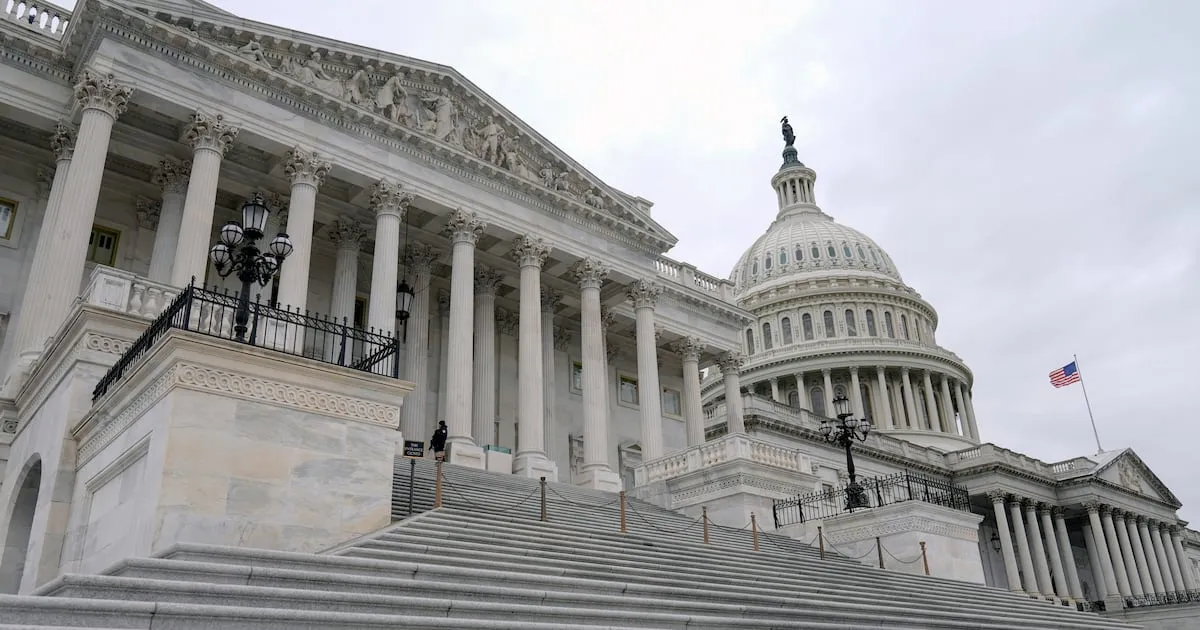

The U.S. House of Representatives voted 219-211 on Wednesday to approve a resolution ending President Donald Trump’s tariffs on Canada, marking a rare bipartisan challenge to the White House trade policy as some Republicans sided with Democrats against party leadership.
This vote represents one of the first instances where the Republican-controlled House directly confronted the president on a key initiative. The measure targets the national emergency Trump declared to justify the tariffs, but implementing the change requires his approval, which remains improbable. The resolution now heads to the Senate for consideration.
Tariffs Stem from Fentanyl Emergency Declaration
Trump invoked the International Emergency Economic Powers Act (IEEPA) last year to impose 35% tariffs on Canada, citing fentanyl concerns at the northern border. These duties exempt goods compliant with the Canada-U.S.-Mexico Agreement (CUSMA).
Rep. Gregory Meeks (D-NY), who sponsored the bill terminating the fentanyl emergency, emphasized Canada’s alliance with the U.S. “Canada is our friend. Canada is our ally,” Meeks stated. “Canadians have fought alongside Americans.”
U.S. government data reveals minimal fentanyl seizures at the Canada border compared to the southern border with Mexico. In response, Canadian officials enhanced border security with additional personnel, drones, and publicized major drug busts.
Republican Perspectives and Procedural Shifts
Rep. Brian Mast (R-FL) highlighted Canadian drug seizures and the appointment of a fentanyl czar as proof of the issue’s severity. “Democrats don’t recognize that there is a crisis that is killing thousands of Americans,” Mast argued, adding that Canada must intensify efforts.
Prior Senate votes overturned the tariffs, but a House procedural rule had blocked similar actions until Tuesday, when three Republicans joined Democrats to end it. Although the Constitution grants Congress authority over tariffs, Republican lawmakers have offered limited public opposition despite private free-trade concerns.
The Supreme Court continues to review Trump’s IEEPA usage, showing skepticism during a November hearing. Rep. Adrian Smith (R-NE) urged delaying the vote until the court decides, noting Canada as a friend but crediting tariffs for prompting talks on issues like the digital services tax, which Prime Minister Mark Carney paused last year.
Democrats Criticize Tariff Strategy
Democrats argued that Trump’s erratic tariffs, statehood suggestions for Canada, and threats—such as delaying the Gordie Howe International Bridge opening between Ontario and Michigan—harm American businesses. Rep. Linda Sanchez (D-CA) dismissed fentanyl threat claims as unfounded, stressing CUSMA’s negotiation and ratification under Trump. “Responsible governments follow the law on trade agreements and don’t negotiate through weird social media tantrums,” she said. “It’s just reckless and frankly, it’s bizarre.”