



Will you really need to get to the airport three hours ahead of your flight? Will airport security be open in the terminal you’re flying from? Will your airport even be open?
Those are questions that few air travelers expected to be asking this year, but answering them has become an unfortunate reality this spring thanks to the partial government shutdown that’s now nearing the end of its seventh week.
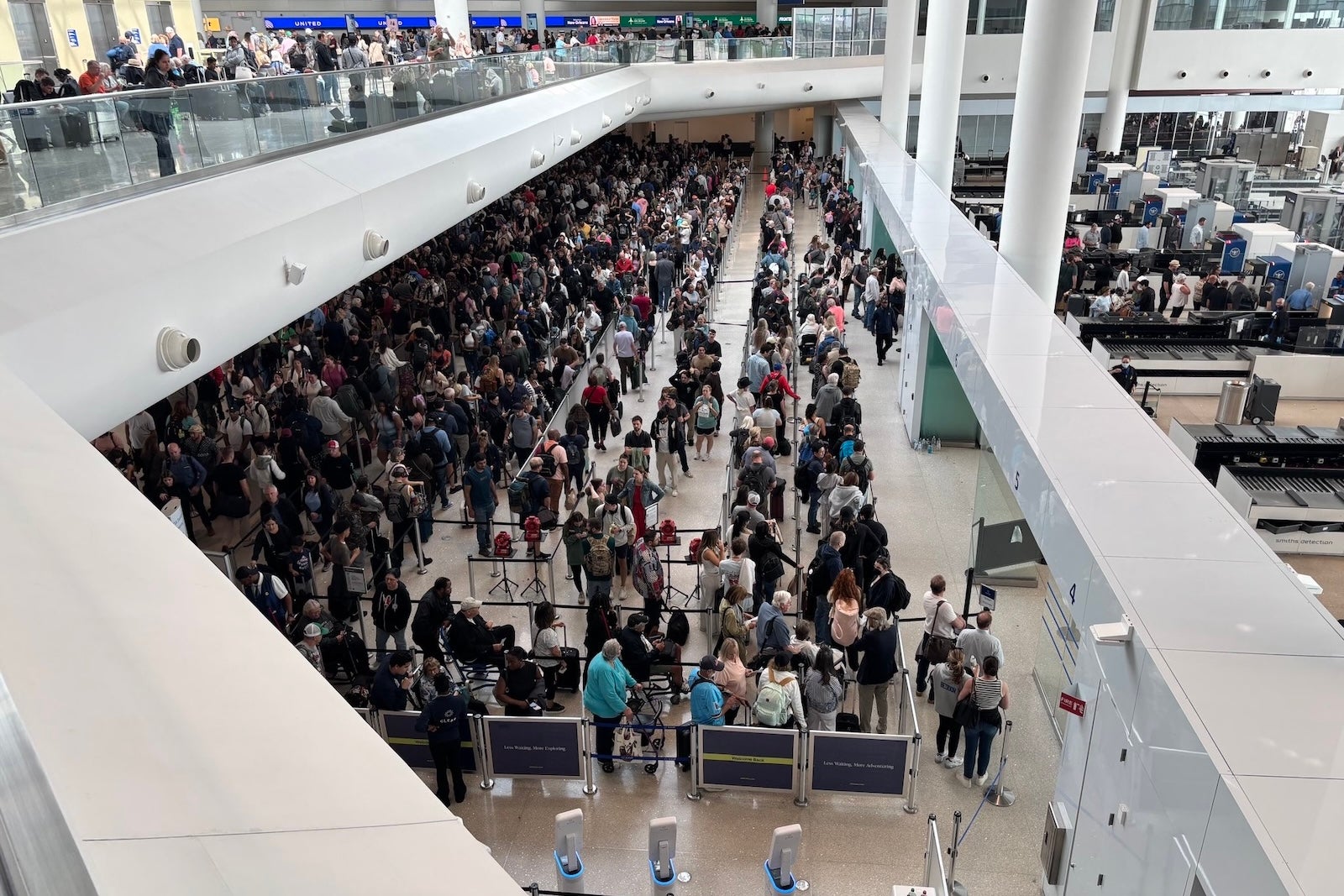
And, increasingly, the effects of the shutdown are being felt by air travelers — specifically in ballooning security checkpoint wait times that are popping up around the country like a game of whack-a-mole.
Here’s what flyers should know about traveling in the weeks ahead.
Why is the shutdown affecting air travel?
The issue: The latest government shutdown has frozen funding for the Department of Homeland Security, which includes the Transportation Security Administration. That means TSA screeners are being asked to work without pay.
In the early days of the shutdown, the TSA’s screening checkpoints largely operated as normal.
But now, after more than a month without paychecks, call-out rates have soared among screeners — many of whom say they’ve been forced to take on other jobs to pay their bills. Others have quit altogether — more than 360 since Jan. 31, the DHS has shared with numerous media outlets.
That’s on top of call-out rates that have gone as high as 10% of the entire TSA workforce on some days.
For travelers, the biggest problems have come at airports where call-out rates have spiked on a particular day, leaving the TSA short-staffed and travelers waiting in unusually long lines.
Reward your inbox with the TPG Daily newsletter
Join over 700,000 readers for breaking news, in-depth guides and exclusive deals from TPG’s experts
Which airports are being hit the hardest?
Airports in Atlanta, Austin, Charlotte, Houston, New Orleans and New York have all drawn national headlines at some point during the past two weeks for unusually long waits at security checkpoints.
In fact, there’s even a “top five” list. The DHS shared numbers with Business Insider on Tuesday showing the airports with the highest average call-out rates since the shutdown began are Hartsfield-Jackson Atlanta International Airport (ATL), New York’s John F. Kennedy International Airport (JFK), Houston’s William P. Hobby Airport (HOU), Louis Armstrong New Orleans International Airport (MSY) and Pittsburgh International Airport (PIT).
Frustratingly for travelers, however, it’s much more complicated to get a real-time sense of where checkpoint wait times have spiked.
Call-outs by TSA workers are impossible to know in advance, meaning that airports are reacting in real time. For example, a spike in absenteeism at Houston Hobby could lead to snaking checkpoint lines on one day, only to return to normal the next day if the call-outs abate.
Still, some airports are now grappling with very tangible effects of the shutdown. Philadelphia International Airport (PHL), for example, has closed several of its screening checkpoints — including the one for its Terminal C — to consolidate flyers among those that remain open.
Can you check on current TSA wait times?
During normal times, checking the MyTSA app to monitor wait times is our normal go-to. However, that information has become unreliable during the shutdown.
Instead, travelers may want to consider checking their airport’s website or social media pages to see if they provide real-time checkpoint data.
The nation’s two busiest airports, Atlanta and Dallas Fort Worth International Airport (DFW), provide TSA wait time information — as do many other U.S. airports.
Elsewhere, others are trying to fill the information void sparked by the shutdown. That includes CNN, which cobbled together its own tracker that monitors waits at the 16 busiest U.S. airports.
Could airports really close because of the shutdown?
Perhaps the most dramatic aviation headline spawned so far by the shutdown has been the possibility that some of the nation’s smaller airports could close if the impasse drags on.
That surfaced Tuesday when Acting Deputy TSA Administrator Adam Stahl said during a Fox News interview that “it’s not hyperbole to suggest that we may have to quite literally shut down airports, particularly smaller ones, if callout rates go up.”
A spokesperson for the agency has since clarified to The New York Times that closures would likely happen only if so many TSA workers called out at a particular airport that checkpoints could not be staffed.
It’s unclear whether such a dramatic scenario might actually happen, though it seems safe to say that the likelihood will continue to tick up the longer that the shutdown persists.
When will the shutdown end?
A million-dollar question if there ever was one.
Simply put, no one knows. It would require action from Washington, where the bipartisan cooperation needed to break the impasse has become increasingly rare.
Eventually, pressure from the worsening air travel chaos could prompt one side or the other to come to the bargaining table. For now, however, there doesn’t seem to be much momentum.
How this shutdown is different from previous ones
Unlike previous shutdowns that affected the entire federal government, this one hits only the DHS — and the TSA that rolls up into it.
So, as far as air travel is concerned, previous shutdowns also suspended pay for air traffic controllers — adding more stress to the system by creating a similar dynamic to what we’re seeing now with screeners.
While it’s only TSA workers going without pay this time, we’re seeing now that’s becoming a big pain point on its own.
What can air travelers do to mitigate the shutdown’s effects?
Unfortunately, not much — except maybe to opt not to travel until it’s over.
And there are fears among industry executives that customers might just do that if the TSA chaos continues to worsen. There’s also anxiety that a prolonged shutdown could wreak havoc on travel around the upcoming World Cup events, as well as with the typically busy summer travel season.
For those who stick with their trips, there are some things to consider.
Get to the airport earlier than you normally would. And check your airport’s latest advice; arriving early by two hours or more might be recommended during peak periods.
If you’re already enrolled in TSA PreCheck, those lines have tended to run closer to normal — even when long call-out queues sprout up. TSA PreCheck also makes passengers eligible for the TSA’s Touchless ID program, allowing for a quicker way to get through airport security on a normal day.
Related reading:

