




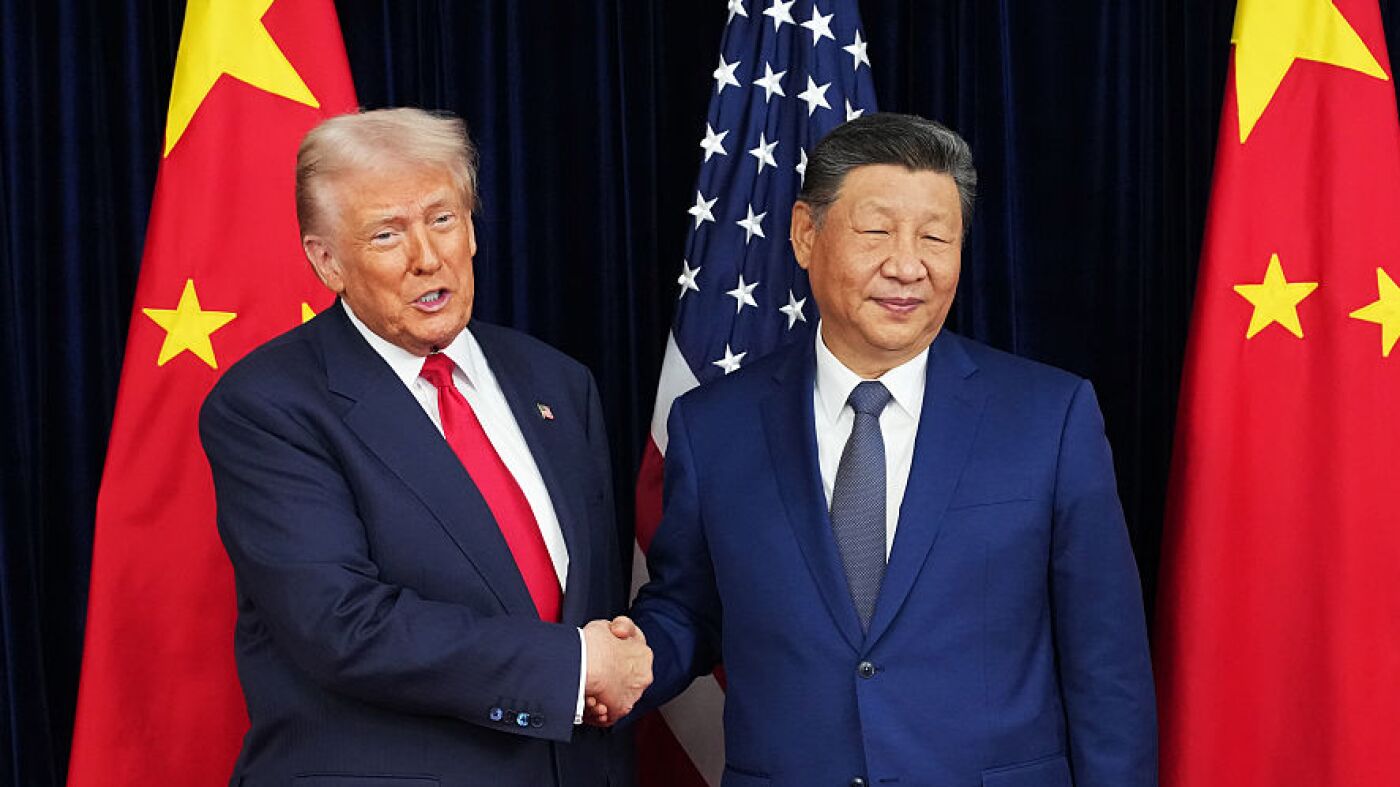

President Trump greets Chinese President Xi Jinping ahead of a bilateral meeting at Gimhae Air Base in Busan, South Korea, on Oct. 30, 2025. Trump heads to Beijing for another meeting with Xi on Tuesday.
Andrew Harnik/Getty Images
hide caption
toggle caption
Andrew Harnik/Getty Images
As President Trump embarks Tuesday on his first trip to Beijing of his second term to meet with Chinese President Xi Jinping, Americans largely view China as an economic rival seeking global dominance, according to an NPR/Chicago Council on Global Affairs/Ipsos poll.
But Americans also want to maintain a strong trading relationship with China and would like to see tariffs reduced to keep costs to U.S. consumers down.
Americans believe China wants to be the dominant world leader
Almost 8 in 10 respondents said China wants to be the dominant world leader.
But by a 56% to 29% margin, they see the threat as more economic than military.
Only 13% believe China represents no threat at all to the U.S.

Most see China as one of the United States’ biggest rivals or adversaries
A majority of Americans see China as either a rival (37%) or an adversary (21%), though more see it as a rival.
Another 1 in 5 see it as a necessary strategic partner, and only 2% view it as an ally.

Of the 10 countries asked about, only Russia was viewed more antagonistically. Two-thirds said they see Russia as an adversary (43%) or rival (21%).
Australia was the country most seen as an ally (51%), followed by Japan, Germany and South Korea. Saudi Arabia and India were the most likely to be seen as strategic partners.
(The poll did not include countries long-considered allies, like the United Kingdom or France, or ones seen as adversaries, like North Korea.)
Tariffs are overwhelmingly viewed as a bad thing — for both countries
Tariffs are strongly viewed as bad for the cost of living in the United States (76%), Americans’ standard of living (70%), creating American jobs (61%), as well as the Chinese (72%) and American (66%) economies.
A majority of Republicans, however, appear to largely agree with the Trump administration argument that tariffs are good for creating jobs (66%), the U.S. economy (64%) and their own standard of living (52%).
Strong majorities of independents and Democrats disagree.
Most want trade to continue between the two countries
A strong majority (62%) opposes significantly reducing trade between the U.S. and China, especially because it could lead to greater costs for American consumers.
That’s a change from 2020 and 2021 when, pre-Trump tariffs, majorities said they would be in favor of reducing trade — even if it meant higher costs.
Now, with Americans feeling the pinch economically, they want lower prices. Given that so many things that Americans buy are made in China, those tariffs have driven up prices in consumer goods.

A majority (58%) said they are against increasing tariffs on products imported from China.
Seven-in-10 said they want to see tariffs reduced toward China in exchange for the buying of more U.S. agricultural products and don’t want trade reduced.
There are some things Americans are wary of when it comes to the trade relationship with China. For example, 7 in 10 want to see U.S. companies prohibited from selling sensitive, high-tech products to China.

A slim majority (53%) is against limiting the number of Chinese students studying in the United States.
But there isn’t broad consensus on these issues.
Three-quarters of Republicans, for example, want to increase tariffs on imported products from China, while 83% of Democrats (and 67% of independents) oppose.
Six in 10 Republicans also want to decrease trade between the countries, even if it leads to higher prices for Americans, and 7 in 10 want to limit the number of Chinese students studying in the United States.
The war in Iran is viewed as bad for everything from national security to the economy
China’s relationship with Iran is likely to be a topic of discussion between President Trump and China’s leaders.
Iran is something of a strategic partner for China, which buys a lot of Iranian oil.
Americans overwhelmingly feel the war in Iran has been a bad thing for everything from the U.S. cost of living (86%) to U.S. national security (65%) and its reputation abroad (72%), according to a Chicago Council/Ipsos survey on Iran that was also released on Tuesday.
Even though a majority of respondents said the war is bad for China, too, more respondents said they thought it has been good for China’s position in the world (36%) than U.S. national security (32%), U.S. relationships with allies (24%), the global economy (14%) or the cost of living in the U.S. (10%).
There are some political divides, too, of course. Solid majorities of Republicans think the war has been good for U.S. national security (63%) and Israel’s security (60%).
Half of Republicans also think the war has been good for the United States’ reputation (50%) and the United States’ relationships with allies (49%).
Democrats and independents feel very differently. Just 8% of Democrats and 29% of independents say that the war has been good for U.S. national security. On the war’s effect on the U.S.’s reputation around the world, just 5% of Democrats and 20% of independents said it’s been a good thing.
Israel continues to be a political flashpoint
A strong majority of Republicans (60%) said the war has been good for Israel’s security, but only 1 in 5 Democrats and 1 in 3 independents said the same in the Chicago Council/Ipsos Iran survey.
Most Republicans (58%) also said Israel is playing a positive role in the Middle East, but 83% of Democrats and 70% of independents said it is playing a negative one.
That mirrors a trend in U.S. politics over the last few years in which more Americans say their sympathies lie more with Palestinians than Israelis. That has been particularly acute among Democrats.
Most Americans don’t follow news of foreign affairs closely
Only 42% said they’re following news about U.S.-China relations at least somewhat closely, the NPR/Chicago Council/Ipsos survey found.
Foreign affairs, except for the war in Iran, don’t come close to domestic issues, like the economy and immigration — 70% said they follow the economy closely, 67% said that of the war in Iran, 65% said that when it comes to immigration.
Only 43% said they’re following events related to the Russia-Ukraine war closely.
These results are based on two national surveys. Both were conducted by Ipsos, using its online panel. The first, dealing mostly with Americans’ views of China, was conducted March 13-15 and includes interviews with 1,025 adults. It has a margin of error of +/- 3.1 percentage points. The second set of questions focused on Iran. It was conducted May 1-3 and includes results from 1,018 adults. It has a margin of error of +/- 3.2 percentage points.

