




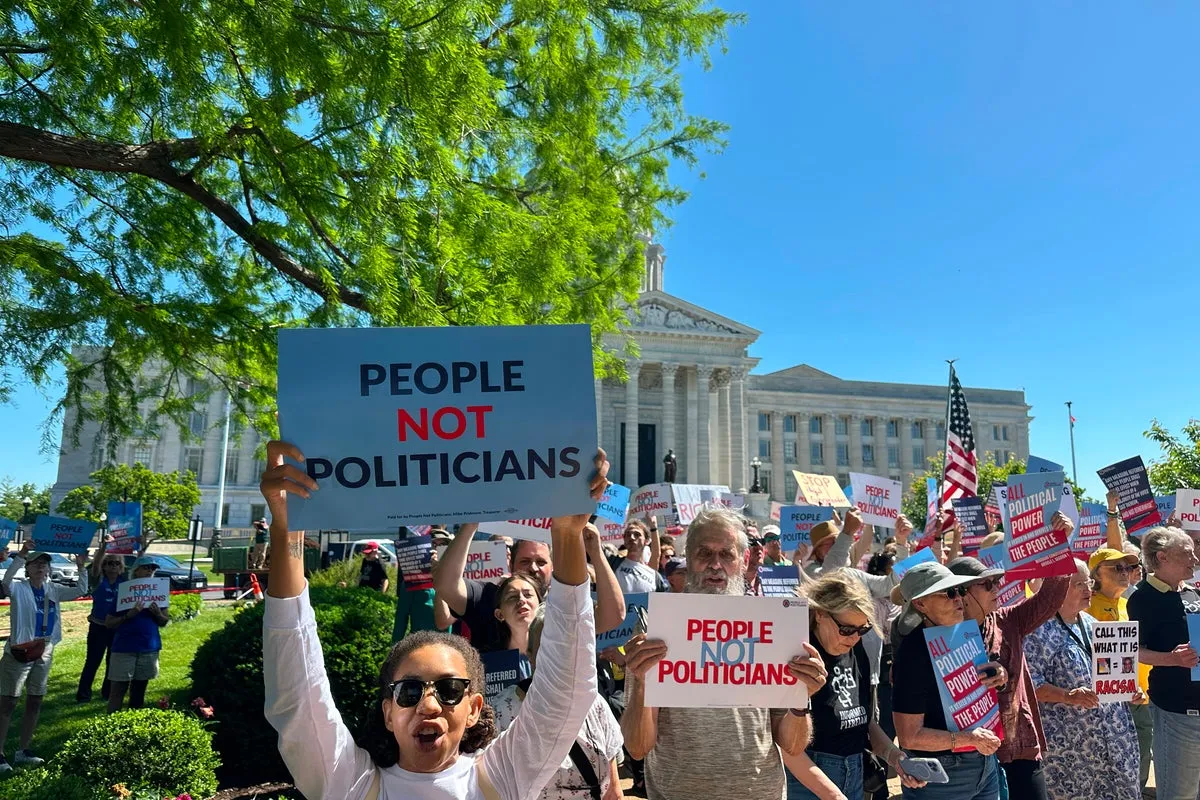

The national push for congressional redistricting intensifies following a Supreme Court ruling that limits the federal Voting Rights Act, enabling states to redraw districts and reduce minority-majority areas. President Donald Trump’s efforts to reshape U.S. House maps produce varied outcomes. Missouri’s Supreme Court upholds a new map that may deliver Republicans an extra seat in the November midterms, while South Carolina senators reject a similar proposal.
Missouri Court Backs New Map Despite Challenges
Missouri becomes the second Republican-led state after Texas to enact new congressional districts at Trump’s urging. The state Supreme Court issues two unanimous rulings upholding the map, calling it a “complete victory for Missouri and for the people’s elected representatives,” according to Republican Attorney General Catherine Hanaway.
Challengers target changes to a Kansas City district held by Democratic U.S. Rep. Emanuel Cleaver, the city’s first Black mayor. The updated map expands the compact 20-mile urban district across 200 miles and 15 counties, creating a “sprawling behemoth that cuts clear across the state to unite territories that share nothing in common,” argues Abha Khanna of the Elias Law Group.
The court affirms a lower court’s finding that the overall map meets compactness standards. “No Missouri court has ever struck down a congressional map for not being compact,” notes attorney John Gore, representing Republicans.
A separate ruling confirms the map’s implementation in December, rejecting calls for suspension amid referendum petitions. Republican officials argue suspension requires validation of signatures by Secretary of State Denny Hoskins by August 4, ahead of primary elections.
South Carolina Senators Block Redistricting Effort
South Carolina’s House approves returning for redistricting to target the state’s sole Democratic seat, but the Senate falls short with a 29-17 vote, two votes shy of the required two-thirds. Five Republicans join Democrats in opposition.
Trump calls on senators via social media to “be bold and courageous” and delay June 9 primaries for new districts. Yet GOP senators question the map’s viability against Democratic U.S. Rep. Jim Clyburn and fear it could redistribute Democrats, risking a 5-2 or 4-3 split.
Republican Senate Majority Leader Shane Massey acknowledges Trump’s influence but prioritizes state interests. “I got too much Southern in my blood,” he states. “I’ve got too much resistance in my heritage.”
Broader Redistricting Shifts Across the South
Republicans anticipate up to 14 additional seats from maps in Texas, Missouri, North Carolina, Ohio, Florida, and Tennessee. Democrats eye six gains in California and Utah, though Virginia’s Supreme Court recently invalidates a map favoring four more Democratic seats.
In Louisiana, a Supreme Court decision strikes down a majority-Black district as racial gerrymandering, influencing redraws. Tennessee adopts new districts, and Alabama Governor Kay Ivey schedules an August 11 special primary for four congressional seats after the court overturns a map with two Black-majority districts. The state shifts to a 2023 map with one such district, opening a Republican opportunity.
Louisiana state Sen. Jay Morris, who proposes eliminating majority-Black districts, reports death threats following a heated hearing where he tells the public to “shut up.” He denies using a derogatory term toward Louisiana Democratic Party Executive Director Dadrius Lanus. State Sen. Gary Carter, a Black Democrat, withdraws from the redistricting committee “to help restore the decorum and focus that this moment demands” after losing his temper. Carter apologizes for any personal attacks and is replaced by state Sen. Royce Duplessis.

