




Lindsey Burrow Reflects on Life After Losing Rob
Lindsey Burrow, widow of the late rugby star Rob Burrow, shares that her husband encouraged her to seek love again following his passing. However, more than a year after his death, she emphasizes that dating remains far from her priorities.
Rob Burrow, a former rugby league player who became paralyzed and lost his ability to communicate after a motor neurone disease (MND) diagnosis, died at age 41 in June 2024. He and Lindsey, now 42, shared nearly 18 years of marriage. They met as childhood sweethearts at age 15. In his final hours at Pinderfields Hospital in Wakefield, Yorkshire, Lindsey found comfort by replaying videos of their wedding day to recall their shared joy.
Lindsey describes their bond as profound from the outset. ‘There was never going to be anyone else I was going to marry. I knew it from the start,’ she recalls. ‘He treated me like a princess. It was love at first sight. It can be a cliché, but it was true for me.’
Rob’s Final Messages and Family Focus
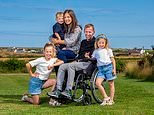
Not a day passes without Lindsey thinking or speaking of Rob, who secured eight Super League titles with Leeds Rhinos. Despite his condition, Rob maintained optimism until the end. He recorded messages for Lindsey and their three children—Macy, 14; Maya, 10; and Jackson, 7—using specialized equipment in his last months.
In one message, he urged Lindsey not to remain alone and to embrace new love. Yet, as a single parent, she prioritizes her family. ‘People do say to me, “I hope you move on,” but it’s not about that,’ Lindsey states. ‘My priority is the children, first and foremost. I don’t know what the future holds but [finding love again] is not on my agenda.’
In her memoir, Take Care, published last year, Lindsey highlights Rob’s unwavering positivity during his MND battle. Their love sustained them through challenges. Rob used eye-tracking technology to send messages like ‘I love you, darling,’ ‘Have a great day,’ or ‘I can’t wait to see you’ when she was at work.
Caring for Rob and Family Impact
Diagnosed with MND in December 2019, two years after retiring from a 17-season career, Rob’s condition worsened over time. Lindsey provided daily care, including feeding, bathing, and carrying him upstairs to bed. She notes the emotional toll on their children as the hardest aspect. ‘The emotional part for me was that MND robbed Rob of being the dad he wanted to be to our three children,’ she explains. ‘He couldn’t read them a bedtime story or kick a ball about with Jackson as he got older, so that was hard for me emotionally. But it never changed my love for Rob.’
The family created cherished memories in Rob’s final days. The children painted his fingers with rainbow ink for a memory book. Lindsey once carried Rob, an avid film fan, to their home cinema for a family viewing of Charlie and the Chocolate Factory. The kids sat on bean bags around his chair, sharing popcorn. Days later, he entered the hospital for the final time.
Macy and Maya performed in a musical on the day of Rob’s death, at his insistence. They later showed him a recording, which brought a ‘big smile’ to his face and lifted his spirits.
Tributes and Lasting Legacy
Following Rob’s death, tributes poured in, including from the Prince and Princess of Wales. Prince William posted on X: ‘A legend of Rugby League, Rob Burrow had a huge heart. He taught us, “in a world full of adversity, we must dare to dream”. Catherine and I send our love to Lindsey, Jackson, Maya and Macy.’
Months earlier, William presented Rob and his friend, Leeds Rhinos captain Kevin Sinfield, with CBEs at Headingley Stadium for their MND advocacy. At the 2024 Leeds Marathon, Sinfield carried Rob across the finish line after pushing his wheelchair the full distance, creating an emotional highlight captured in photos, including a kiss of affection.
Rob reflected: ‘The Marathon was one of the most important and special events I’ve done and meant so many things to so many people. But for me, it was about friendship and crossing the finish line with my mate Kev will live with me forever and it created a platform to raise funds and awareness for MND charities.’
Their efforts raised £16 million, increasing to £20 million after Rob’s death, funding the Rob Burrow Centre for Motor Neurone Disease at Seacroft Hospital in Leeds. This UK’s first dedicated MND facility supports care, research, education, and holistic needs, inspiring similar centers nationwide.
During the CBE ceremony, Rob asked William to open the center, a request the prince honored last November. William also contributed the foreword to Lindsey’s memoir, praising her resilience in an audio recording: ‘Despite the advanced nature of Rob’s condition, I was struck by the incredible strength, positivity and incredible resilience of Lindsey. Rob told me she is far tougher than any of the men he has played with or against over the years. I know I am not alone in feeling great admiration for how she has kept going in the face of adversity. This book tells Lindsey’s story of perseverance and love. By sharing her story, she is shining a light on those who are dealing with incredibly difficult situations, putting other’s needs before their own and making great personal sacrifices every day.’ He added that the book offers ‘comfort and optimism’ to others and inspires mutual support.
Understanding Motor Neurone Disease
Motor neurone disease primarily affects individuals in their 60s and 70s but can occur at any adult age. It stems from the gradual failure of motor neurones, cells in the brain and nerves that control movement. The exact cause remains unknown, though a family history of MND or frontotemporal dementia increases risk in some cases.
Early signs include ankle or leg weakness, difficulty climbing stairs, slurred speech, swallowing issues, weak grip, and unexplained weight loss. Health experts recommend consulting a GP for these symptoms, who may refer to a neurologist. For those with family history, genetic counseling can assess risks and testing options.

