



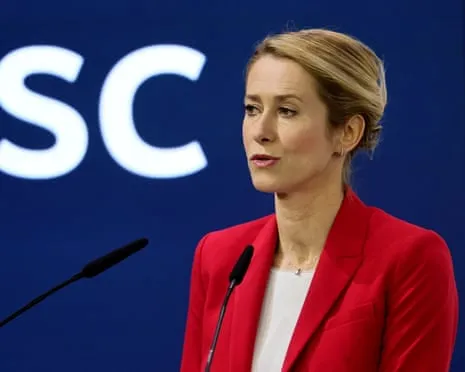

Europe’s foreign policy chief Kaja Kallas dismisses U.S. assertions that the continent faces civilizational decline, labeling such rhetoric as trendy ‘euro-bashing’ from Washington. She emphasizes that the U.S. recognizes it cannot resolve the Ukraine conflict without Europe’s participation and agreement.
Munich Security Conference Tensions
Kallas’ comments conclude a challenging three-day Munich Security Conference, where global leaders and security experts debated transatlantic ties, a robust European role in NATO, and Ukraine peace negotiations.
U.S. Secretary of State Marco Rubio delivered a measured address on Saturday, blending diplomacy with a clear demand: Europe must align with U.S. priorities on mass migration, free trade, and increased defense budgets to sustain collaboration.
Kallas Counters Criticism
Addressing the conference’s final day, Kallas implies Rubio’s statements target a U.S. domestic audience. “Euro-bashing” has become “very fashionable” despite Europe’s many strengths, she notes.
“When I travel around the world, I see countries that look up to us because we represent values that are still highly regarded,” Kallas states. She refutes notions of a ‘woke, decadent’ Europe on the brink of erasure, adding, “In fact, people still want to join our club and not just fellow Europeans. In Canada, I was told over 40% of Canadians have an interest in joining the EU.”
Kallas challenges U.S. critiques of European media freedom, highlighting Estonia’s second-place global ranking versus the U.S. at 58th. Given Europe’s human rights achievements, she finds such accusations difficult to accept. “We are… pushing humanity forward, trying to defend human rights and all this, which is actually bringing also prosperity for people. So that’s why it’s very hard for me to believe these accusations.”
Ukraine Membership and Transatlantic Partnership
A staunch Russia critic, Kallas indicates the EU lacks readiness to set a Ukraine membership timeline, deeming 2027 accession improbable.
Rubio, the day prior, extended an emotive yet conditional partnership proposal, affirming shared continental roots and America’s European heritage. In his keynote, he outlines U.S. ambitions for a new global order: “While we are prepared, if necessary, to do this alone, it is our preference and it is our hope to do this together with you, our friends here in Europe.”
He acknowledges U.S. directness stems from deep concern for Europe’s future and intertwined destinies.
Navalny Poisoning Report
Post-conference in Bratislava, Slovakia, Rubio sidesteps U.S. intelligence absence from a joint European report—backed by five agencies including the UK’s—implicating Russia in opposition leader Alexei Navalny’s poisoning via a South American dart frog toxin.
On U.S. non-participation, Rubio explains: “Those countries came to that conclusion. They coordinated that. We chose – doesn’t mean we disagree with the outcome. We just, it wasn’t, our endeavour. Sometimes, countries go out and do their thing based on the intelligence they’ve gathered.”
British Prime Minister Sir Keir Starmer affirms unprecedented UK-U.S. intelligence collaboration.

