


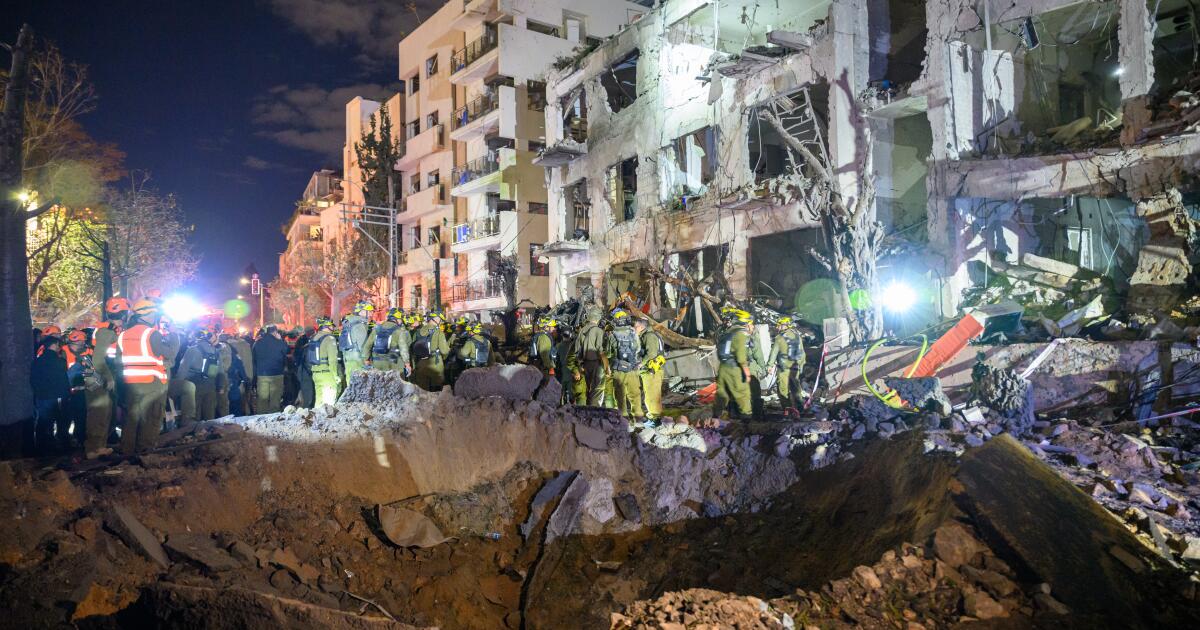

The U.S. and Israel gambled on “decapitation” in Iran, killing Supreme Leader Ayatollah Ali Khamenei and many others. History shows the danger of this approach in nationalist conflicts: It often works tactically — and fails strategically.
Although the weekend’s “shock and awe” bombing campaign and the U.S.-led regime change remind many of Iraq, it is not the most instructive case. That would be Chechnya.
On April 21, 1996, Russian forces executed one of the most precise assassinations of the modern era.
The target was Dzhokhar Dudayev, leader of Chechnya’s separatist war against Moscow. Repeated attempts to locate him had failed. He was mobile and deeply cautious.
President Boris Yeltsin requested talks. Dudayev refused. Only after King Hassan II of Morocco agreed to serve as intermediary — in a mediation effort encouraged by the United States — did Dudayev accept a call. As Dudayev spoke on a handheld satellite phone with the Moroccan monarch, Russian aircraft waited beyond visual range.
Signals intelligence locked onto the phone’s emissions. Two missiles homed in. Dudayev was killed instantly.
By operational standards, it was flawless. The 100% tactical success turned more on James Bond tricks than Tom Clancy technology. Diplomatic choreography created electronic exposure. Precision weapons did the rest. No ground assault. No Russian casualties. No ambiguity.
For airpower theorists shaped by the 1991 Persian Gulf War, this was the embodiment of a powerful idea largely refined in U.S. planning circles: strategic bombing could kill, overthrow or paralyze enemy leaders and compress wars into days. Like the Texas Ranger slogan — “One riot, one Ranger” — the implied promise was “one war, one raid.”
The rationale behind decapitation assumed regimes are hierarchies: Remove the apex, and the structure collapses. In Chechnya, only the first step happened — which was predictable. Nationalism is not stagnant and not hierarchical. It grows after foreign attacks and evolves into more powerful identity coalitions.
When U.S. strikes failed to kill Moammar Kadafi in 1986 or Saddam Hussein numerous times in the 1990s, many airpower advocates concluded near misses were the problem. If the leader actually died, the regime would fracture.
Russia — with a critical U.S. assist — proved the execution could be perfected.
But execution was never the core variable.
Leadership assassination in international disputes does not simply remove authority; it redistributes it under emotional mobilization. That is exactly what has begun in Iran, after months of succession planning with the expectation that 86-year-old Khamenei could be assassinated. A top Iranian official said an interim committee would lead the government while a new leader is chosen.
This is the pattern after decapitation: Martyrdom transfers legitimacy. The successor must demonstrate resolve, not flexibility. The political market rewards maximalism. Moderation becomes disloyalty.
Dudayev’s death did not fragment resistance. It sanctified it.
Power shifted toward commanders less constrained by negotiation and more willing to escalate. Among them was Shamil Basayev. The center narrowed. The emotional intensity widened.
The strike succeeded tactically but was a strategic catastrophe, triggering greater nationalism and violence that fueled years of bloody war with Russia.
This is the “smart bomb” trap: A discrete strike intended to compress a conflict instead transforms its character.
Once identity is fused by martyrdom, escalation becomes politically easier. Retaliation broadens. Successors have fewer incentives to compromise and greater incentives to demonstrate defiance. Diplomacy becomes less workable and war far more likely. What began as a precision event evolves into unstable escalation.
The phase shift now that military superpowers can seemingly abduct or kill foreign leaders with precision is not technological. It is political.
Iranian leaders prepared structured succession chains — multiple rungs deep — in anticipation of targeted strikes. Now that Khamenei is dead, there are several plausible possibilities — none necessarily stabilizing: a rapid infusion of nationalist energy within the Islamic Revolutionary Guard Corps; a leadership struggle resolved through nationalist hardening; diffusion of authority across semi-autonomous networks; and expanded activation of Iran’s many militant proxies across the region.
Each pathway increases escalation risk. All diminish future U.S. control of the situation.
Iran is not Iraq in 2003. It is roughly six times larger in territory and four times larger in population. It possesses dense partner networks across the Middle East capable not only of missile strikes — which began almost immediately, as Tehran had promised — but also asymmetric retaliation, including targeted operations against leaders allied with the U.S. in the region.
Israeli leaders may be well protected from Iranian nationalist plots. But are Saudi, Emirati and others who have worked with the Trump administration? Decapitation is not a one-sided instrument.
Nor does fragmentation guarantee calm. A fractured Iran of nearly 90 million people could produce competing nationalist centers seeking legitimacy through confrontation. The escalatory options available after a martyrdom event are broader than before the strike.
Precision warfare promises control but can clearly escalate chaos instead. The most dangerous outcome of a campaign like the U.S.-Israeli strikes is not operational failure. It is operational brilliance. Because that is when leaders believe escalation remains under control — just as the conflict crosses the threshold into something far larger.
A perfect strike can be the beginning of a much bigger war.
Robert A. Pape, a professor of political science at the University of Chicago, is the director of the Chicago Project on Security and Threats. He writes the Substack “The Escalation Trap.”

