





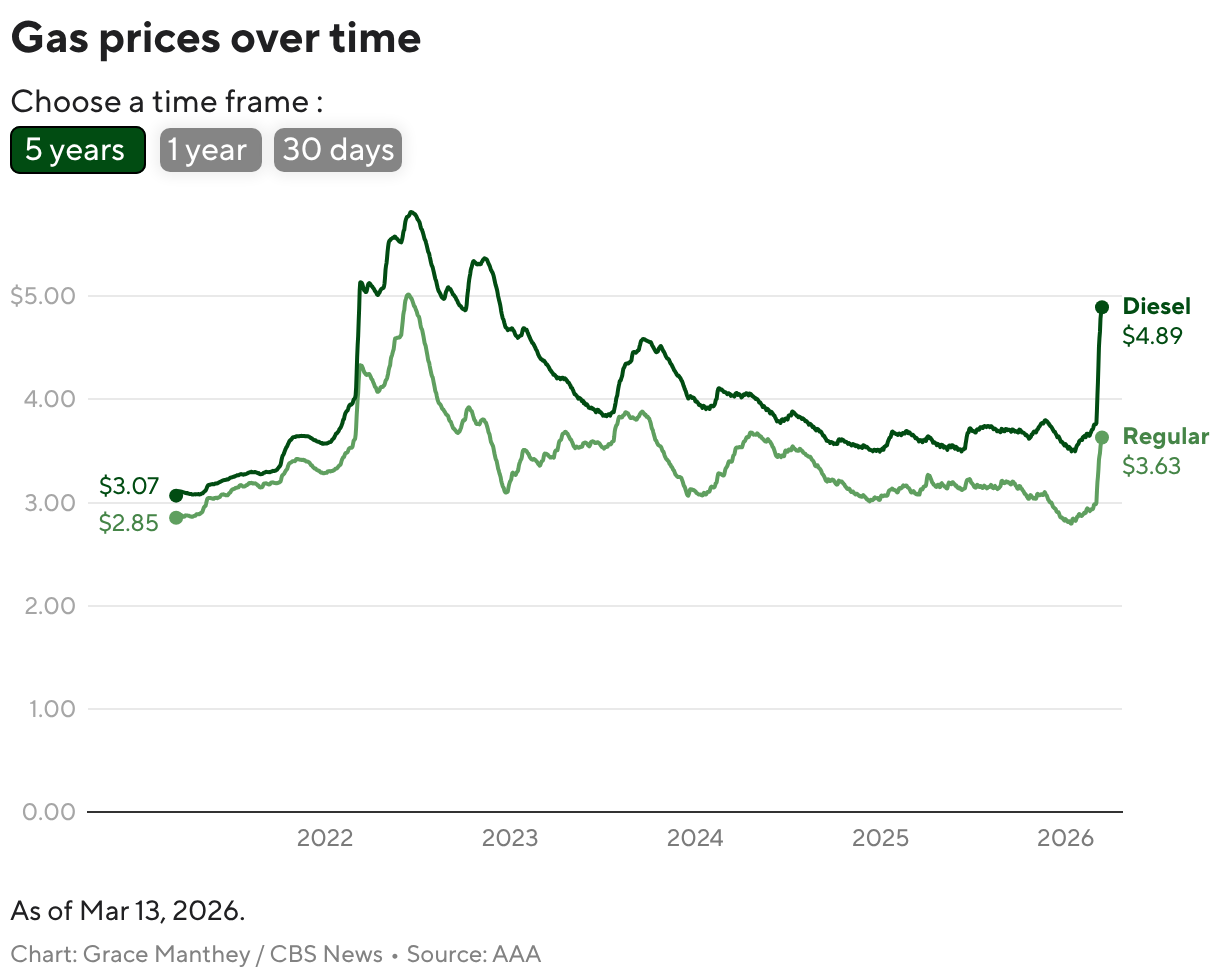
Although the Trump administration is pulling multiple levers to tame energy costs amid the widening Iran war, the average price of gasoline in the U.S. on Friday neared $4 a gallon, raising questions about whether those efforts are working.
The most effective measure for bringing down oil prices would be to reopen the Strait of Hormuz, the vital Persian Gulf waterway that handles some 20% of the world’s oil and natural gas supplies, according to experts. The strait remains virtually closed as violence in the region escalates, bringing shipping traffic to a near-halt.
In the meantime, the U.S. is turning to other options to counter rising oil prices, with Brent crude, the international benchmark, at about $108 a barrel, a 48% surge since the start of the war. The Trump administration’s strategies range from tapping the Strategic Petroleum Reserve to easing government regulations that boost the cost of petroleum products.
“The fundamental problem is that all these things they’re doing are measures to, ‘How do I counteract having taken 20% of the world’s supply off the market?’,” Willy Shih, professor of management at Harvard Business School and energy market expert, told CBS News.
President Trump and his energy team have considered “all the options on the table” to mitigate rising oil prices, White House spokeswoman Taylor Rogers told CBS News. These include releasing emergency oil reserves, providing political risk insurance from the U.S. Development Finance Corporation to cargo ships in the Gulf and temporarily freeing up sanctioned oil, among other options, she said.
Oil and gas prices will drop rapidly, even dropping below their pre-war prices, once the U.S. achieves its military objectives, she added. “As a result, American families will benefit greatly in the long term,” she said.
Here’s what experts said about the various measures to keep a lid on energy prices.
Tapping the Strategic Petroleum Reserve
President Trump ordered the release of 172 million barrels of oil from the U.S. Strategic Petroleum Reserve (SPR) on March 11, when Brent crude had reached $92 a barrel. The oil release began this week and will roll out over 120 days.
The SPR was created in the 1970s to provide an economic cushion against energy disruptions, such as a hit to oil refineries from a natural disaster.
The release marks the second-largest in the reserve’s history after former President Joe Biden’s move in 2022 to withdraw 180 million barrels. Mr. Biden had tapped the SPR to counter the effects of Russia’s invasion of Ukraine in February of that year, along with lingering inflation from the pandemic. Those twin crises had led to U.S. gas prices surging to an average of more than $5 a gallon.
The Trump administration’s SPR release is far too small to counter the Iran war’s impact on energy supplies, Clayton Allen, a practice head at the global political risk research firm Eurasia Group, told CBS News.
The International Energy Agency estimates that Gulf countries have cut oil production by 10 million barrels per day due to supply constraints since the outbreak of hostilities in Iran. Before the war, about 20 million barrels of oil traveled through the Strait of Hormuz each day.
“The release won’t have much impact at all,” added Patrick De Haan, petroleum analyst at GasBuddy, which tracks gas prices around the U.S. “It’s kind of like trying to replace a water main with a straw.”
Releasing oil from the Strategic Petroleum Reserve also takes time. The fastest the U.S. has been able to draw down supplies from the reserve is 1 million barrels a day, although the Trump administration is aiming for 1.4 million barrels a day, Allen noted.
“There are physical constraints on their ability to do that,” he said. “So U.S. oil is not going to reach the market as quickly as people expect.”
Allen added, “If people are expecting this to suddenly take us back to $3.50 gasoline, that’s not really realistic.”
Waiving the Jones Act
Mr. Trump on Wednesday ordered a 60-day waiver of the Jones Act, a roughly 100-year-old law that requires goods shipped between American ports to be carried on ships that are U.S.-built, -flagged and -crewed.
Temporarily suspending the law will allow foreign ships to move fuel between U.S. ports, potentially boosting local supply and reducing prices at the pump. A recent analysis from the Center for American Progress, a nonpartisan policy institute, estimates that waiving the law would reduce gas prices by 3 cents per gallon.
The waiver is “too little, too late” to help keep a lid on oil and gas prices, Harvard’s Shih told CBS News, adding that “It is a drop in the bucket in terms of influencing prices when you’ve taken 20% of the global supply offline.”
Lifting Russian oil sanctions
On March 12, the U.S. said it would temporarily approve the purchase of Russian oil that’s already loaded on ships that have put out to sea. Treasury Secretary Scott Bessent said the one-month waiver “will not provide significant financial benefit to the Russian government.”
It’s unclear whether lifting those sanctions on Russia will do much to benefit U.S. motorists according to experts. The reason: There are only about 124 million barrels of Russian oil currently at sea globally. That’s equal to about six days’ worth of normal shipments through the Strait of Hormuz, or slightly more than one day’s worth of global consumption of about 101 million barrels per day.
Would oil prices have moved higher without these measures?
Oil has brushed up against $120 a barrel a few times this month, but for now remains below that threshold.
Allen of Eurasia Group told CBS News that the Trump administration’s actions are preventing oil from surging higher.
“Is that a success? It depends on how you define success, and really, the determination of how big the price impacts are going to be is how long this war continues,” he said.
Other options under consideration
The Trump administration is considering taking additional steps to tamp down energy prices, with Bessent telling Fox Business on Thursday that it may “unsanction” Iranian oil that’s already on the water.
“It’s about 140 million barrels, depending on how you count — that’s 10 days to two weeks of supply, that the Iranians had been pushing out, that would have all gone to China,” Bessent said.
In a related effort to stabilize global oil prices, the U.S. said it is allowing Iranian oil tankers to cross the Strait of Hormuz. “The Iranian ships have been getting out already, and we’ve let that happen to supply the rest of the world,” Bessent said in an interview with CNBC on Monday.
Roughly 80% of Iran’s oil is shipped to Asia, with China accounting for the lion’s share of that consumption.
The U.S. is also considering waiving a regulation that bans gas stations from selling a blend called E15 from June 1 to Sept. 15, Reuters reported. The blend isn’t sold in warmer months because its higher ethanol content means it evaporates more easily in hot weather, which can contribute to air pollution.
Some state lawmakers are also pushing to waive local gasoline taxes, aiming to lower prices at the pump. The Georgia House of Representatives on Wednesday approved a measure that would suspend the state’s 33-cent per-gallon gas tax for 60 days, while lawmakers in Connecticut, Maryland and Pennsylvania are considering similar approaches.
On the foreign policy front, Mr. Trump is pressuring other countries to help open the Strait of Hormuz. Six major U.S. allies on Thursday voiced their “readiness to contribute to appropriate efforts to ensure safe passage through” the strait, although the leaders of the U.K., France, Germany, Italy, the Netherlands and Japan provided no specifics.
“We don’t have to end the war — we have to have confidence about the ability of ships to move through Hormuz,” David Victor, energy expert and a professor of public policy at the University of California San Diego, told CBS News. “There’s not a lot else you can do over the short term beyond what’s being done already.”
Once the strait reopens, Victor added, “There would be immediate effects in the market. There would be a big reduction in price and improvement in liquidity.”
[/gpt3]

