




I love coaching basketball. Being around young people, seeing their potential and helping them become the best versions of themselves is incredibly gratifying. But the job also offers a glimpse into how fragile it can all be. One injury, one bad break, a change in circumstances can shift everything for a player in a single moment.
Life is the same way. I found that out when I lost my dad, Malcolm Kerr, to gun violence in 1984 when I was just 18 years old. He was 52 and missed out on so much. I think about him every day. My family’s loss was profound and has shaped how I feel about gun violence, and why I’m so passionate about trying to move the needle on how we view this issue across America.
We talk about gun violence like it’s abstract, like it’s theoretical. But it isn’t. It’s human loss. That’s the real cost, and the families of children lost to gun violence carry that loss every day.
Gun violence is now the No. 1 killer of children in America. That’s astonishing, and it’s unforgivable. But what’s just as dangerous is becoming numb to it — reading about it again and again, shaking our heads and going back to our lives unchanged.
I’ve spoken out after shootings before, after Parkland, after Uvalde, after too many. I’ve said I’m tired, and I meant it. I’m tired of moments of silence that don’t lead to anything. I’m tired of condolences as a substitute for action. We can’t keep saying “this is horrible” and then move on like that’s enough.
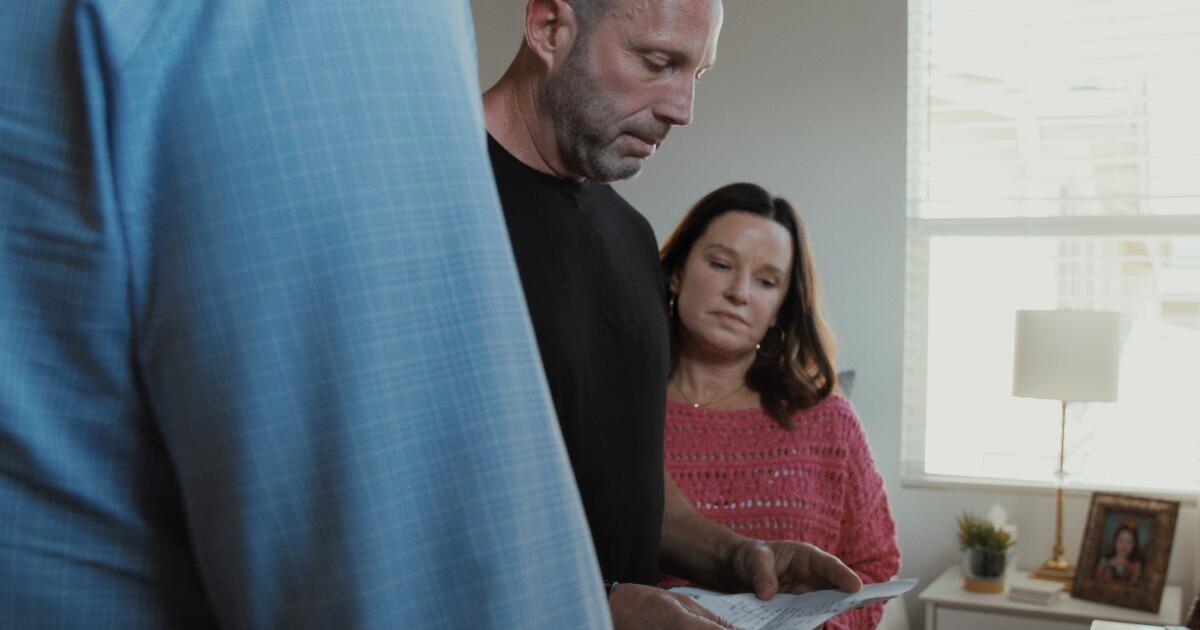
A scene from “All the Empty Rooms.”
(Courtesy of Netflix)
When I first heard about “All the Empty Rooms,” a short documentary released last year about the victims of gun violence, I knew it was a project I believed in. I joined as an executive producer because I could see director Joshua Seftel approaching this crisis with the care and respect it deserves. What mattered to me right away was how the film listens to families. It gives them room to speak about their children without exploiting their stories into politics or spectacle. There’s a dignity in that choice, which is difficult to find in the way our country usually talks about gun violence.
We’ve all seen the headlines and we’ve all heard the escalating numbers. But at a certain point, human nature kicks in. We get used to it. We turn away. We tell ourselves we can’t carry all of it. I understand that instinct. I feel it, too. But we can’t live there.
“All the Empty Rooms” follows journalist Steve Hartman and photographer Lou Bopp as they travel across the country, stepping into the bedrooms of children killed in school shootings. They don’t rearrange anything. They don’t explain what you’re supposed to feel. They just let you sit with what’s left behind: the bed, the posters, the trophies, the trinkets — the little things that tell you who a child was before everything stopped.
One moment that stayed with me is when Bopp takes his shoes off before entering one of the bedrooms. It’s a small gesture, but it says everything. Respect. Humility. An understanding that you’re stepping into a sacred space.

A child’s shoes in “All the Empty Rooms.”
(Courtesy of Netflix)
As a parent and a grandparent, that’s the part that hits hardest. I have two sons and a daughter. Two granddaughters. Watching “All the Empty Rooms,” I kept thinking, “This could be our kids. Our family.” That’s the power of the film. It takes something we’ve learned to keep at arm’s length and brings it right back to where it belongs.
“All the Empty Rooms” reaches people in a way arguments can’t. Whether people agree on policy or not, they recognize the humanity in these parents and the weight of their grief, the chill of the voids left in their lives.
The parents are not asking to be symbols. They’re talking about their children, about love, about absence, about time standing still. If we really allow ourselves to feel what these families are living with, we might finally be ready to do something about it.
Steve Kerr is the head coach of the NBA’s Golden State Warriors.