





David Yturralde arrived at the mushroom talk in Newport Beach recently armed with a pen and paper and a host of questions. The goal, he said, was to demystify those fascinating fungi that popped up on his grass after heavy winter rain.
He’s long been interested in the mushrooms that sprout on the front lawn of his San Clemente home, but he’s always been too timid to pick any. And there’s no way he’s collecting any to taste, he said.
“Mushrooms are mysterious little things because right away your parents tell you, as a child, don’t eat that,” he said.
But after hearing about recent illnesses and fatalities related to the death cap mushroom, Amanita phalloides, in California, Yturralde and several others who gathered in the Environmental Nature Center’s conference room sought answers about which mushrooms in the area are deadly.
In the past three months, California has seen a sudden uptick in the number of people becoming sickened and dying after accidentally eating poisonous mushrooms found in the wild. While the fatalities have occurred along the Central Coast and in Northern California, the phenomenon has prompted concerns and discussions among mycological societies and amateur foragers across the Golden State.
The most recent death was reported on Jan. 27 by public health officials in Contra Costa County who confirmed a 60-year-old man died after eating wild mushrooms, bringing the total number of fungi-related fatalities to four.
Public health officials could not identify which wild mushroom caused the man’s death, said Nicola Gillette, spokesperson for Contra Costa Health. But officials said the man, who was described as being of “Hispanic descent,” died after eating wild mushrooms foraged at a regional park in the county.
“Preliminary information indicates the man may have mistaken the mushroom for a variety that is edible in his home country,” Gillette said.
The California Department of Public Health reported 39 death cap-related illnesses, including four fatalities and three liver transplants, between Nov. 18 and Jan. 18.
In a typical year, the California Poison Control Center may receive up to five cases of poisonous mushroom-related illness, according to authorities.
The last major outbreak occurred in 2016 with 14 reported cases, and while there were no deaths, three people required liver transplants and one child suffered a “permanent neurologic impairment.”
In this slew of cases, the California Department of Public Health has reported that 60% of affected individuals spoke Spanish as their primary language — other affected people speak Mixteco, Mandarin Chinese, Ukrainian, Russian and English.
The incidents that have occurred within the Latino community this year could be an anomaly, said Mike McCurdy, president of the San Francisco Mycological Society.
The society has been working closely with the state public health department to create a warning sign and fliers with a QR code leading to more information in multiple languages that can be distributed in recreational areas such as parks, nature preserves and hiking trails.
Generally, people are accidentally poisoned after they mistakenly eat a wild mushroom they thought was safe, McCurdy said.
Some situations are more nefarious. In 2025 Erin Patterson, a 51-year-old Australian woman, was sentenced to life in prison for murdering three relatives and trying to kill another by intentionally feeding them a beef Wellington that included poisonous fungi in the ingredients.
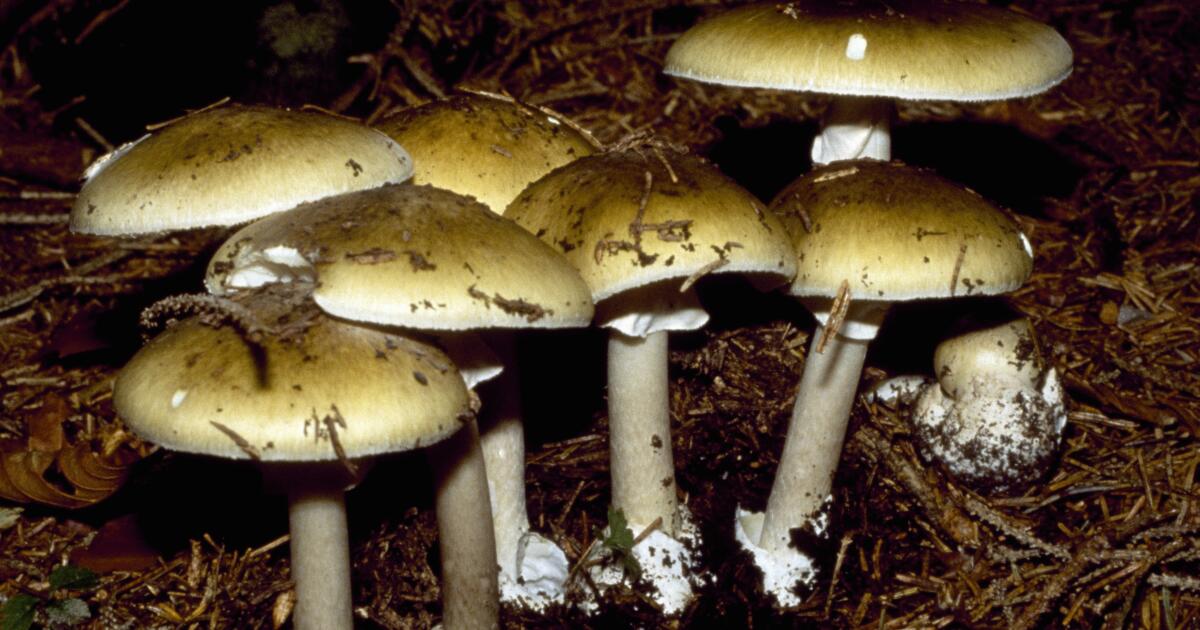
Two of the most toxic mushrooms that can be found in the state are the death cap and the western destroying angel mushroom, Amanita Ocreata. Death cap mushrooms have a dome-shaped cap that may have olive or yellowish tones, while the western destroying angel has a cream or ochre-colored cap.
At the start of Joanne Schwartz’s presentation in Newport Beach recently, the expert amateur mycologist acknowledged the number of recent deaths caused by toxic fungi.
“Guess what, these mushrooms are right here in Orange County,” Schwartz said. “You might even have one on your lawn.”
She warned the roughly 20 attendees that some edible mushrooms look like toxic ones, many grow side by side and if a person collects a mushroom species in one part of the world, there might be a deadly look-alike somewhere else.
While mushroom poisonings have been concentrated further north, word of the deaths and illnesses has trickled down to Southern California, sparking fear among those who are wary of the spongy wonders, said Rudy Diaz, president of the Los Angeles Mycological Society.
When mushroom poisonings make the headlines, people who aren’t a part of the fungi community tend to see those who are as being irresponsible or ruining habitats, he said.
On a recent hike with a friend, Diaz said he was looking at some mushrooms he found on the trail and a stranger “chided me for doing something so risky.”
“For people who have been able to redevelop that kind of spiritual connection with the land through their years of observation and study, eating things that you forage is kind of like an active communion with these environments that you love and you’ve come to know,” Diaz said.
But experts, including Diaz, say eating mushrooms isn’t a necessary part of observing, learning and appreciating them.
For those who are well versed in mushrooms in Southern California, there isn’t a sense of alarm of possible poisonings because the toxic mushrooms are a lot less conspicuous in the southern part of the state.
In Northern California, death caps are abundant in local parks, “whereas here in Southern California you have to dig through some oak litter before you tend to spot things,” Diaz said.
Still, the message from the mycology society and mycologists throughout the state is one of caution: Unless you’re familiar with your local environment, have an expert you can consult or are part of a mushroom or foraging club, you should not be eating wild mushrooms.
Mycologists use dichotomous keys to identify the species of mushroom based on its physical characteristics including the cap, stem, ring and gills.
The mistake people outside the fungi community or beginners make when identifying mushrooms is solely relying on social media, a field guide or an app like iNaturalist, said Bob Cummings, a leading mycology expert in Santa Barbara. Just comparing the mushroom to a photo isn’t enough to make an accurate species identification, he said.
Schwartz encouraged the public to be active participants in community science. Her hope, she said, is that people get engaged with mushrooms because there’s so much to learn about the more than 1,500 species in Orange County and over 3,000 types of fungi in the state.
Mushrooms, toxic or not, are OK for all to pick and observe, she said.
Yturralde came away from the weekend discussion with his mind made up.
“I’m open to learning more about mushrooms, but I’m not interested in eating anything that I find,” Yturralde said. “In other words, I learned that it’s best to only eat what’s in the [grocery store].”

