



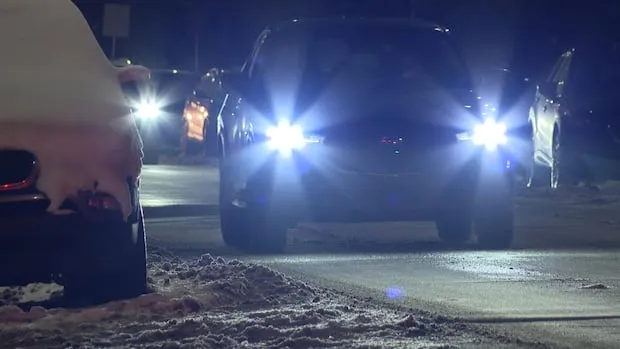

Drivers increasingly report discomfort and vision issues when navigating roads after dark, with experts pointing to super-bright LED headlights as the primary culprit.
Rising Complaints from Healthy Drivers
Saskatoon optometrist Rachael Berger observes a surge in patients of all ages experiencing night vision problems. “I’m seeing an alarming number of perfectly young, healthy individuals coming in and saying, ‘I’m having a hard time seeing at night, what’s going on,’” Berger states. She reassures them that the issue stems from LED headlights prevalent on modern vehicles, not personal vision decline.
At night, the eye’s rods activate for low-light vision. Berger explains, “When you’re driving at night and your rods are activated, and all of a sudden this blast of light comes, it can be very jarring, because our night system isn’t prepared or necessarily expecting that.”
The Science of Discomfort Glare
LED headlights shine up to four times brighter than traditional sources, leading to discomfort glare—a painful sensation from intense light that induces visual fatigue. Prolonged exposure from oncoming traffic or rearview mirrors exacerbates the problem, often termed “glare monsters.”
Vehicle lighting consultant Daniel Stern, chief editor of Driving Vision News, warns that constant glare demands mental effort, diverting attention from the road. “If you’re having to devote attention to dealing with glare by gritting your teeth or looking away, you’re not looking where you need to be,” Stern cautions.
Calls for Stricter Regulations
Stern advocates aligning standards for new and existing vehicles, including routine headlight aim checks— a practice that has declined despite brighter beams becoming more misalignment-sensitive. He criticizes aftermarket LED bulb swaps, noting, “A lot of people think, ‘Well, I had a great result putting LED bulbs in my dining room or garage. I’ll put them in my headlights too.’ The problem is that’s like putting on somebody else’s eyeglasses, the optics are mismatched.”
North American standards prioritize maximum brightness over glare control, influenced heavily by U.S. policies. Transport Canada last revised headlight rules in 2018 to enhance visibility, height requirements, and auto-leveling, but these apply only to factory-equipped vehicles. Provinces oversee maintenance and modifications, with experts advising against non-OEM LED replacements.
Industry and Government Perspectives
David Adams, president of Global Automakers of Canada, argues that post-sale alterations shift responsibility to modifiers. He highlights challenges in crafting unique Canadian rules given low sales volumes and vehicle diversity, such as higher-riding SUVs. “At the end of the day, anything is possible in terms of trying to resolve some of these issues but it does come down to, unfortunately, to money and adding cost to the vehicle,” Adams says. “Currently in North America, I would say vehicles are almost unaffordable.”
Transport Canada runs a national survey on headlight glare’s impact on safety and visibility, with results due in May. The agency also joins a UN task force on glare reduction.
Municipal Push for Action
Vancouver and Victoria city councils recently urge federal updates to address excessive brightness. Vancouver Coun. Sean Orr, inspired by international approaches, questions, “When I first saw them, I thought, how are these legal? Are people modifying their own cars, what’s happening.”
Suggestions include European-style auto-dimming, adaptive lights, and cornering beams that follow turns to avoid blinding others. Vancouver Mayor Ken Sim plans a letter to Transport Canada, to be raised at the Federation of Canadian Municipalities conference in June.
Stern views these motions as growing political momentum, likening the issue to past air pollution battles: “I kind of think of it like air pollution. It’s a social ill but until the political will developed to clean up the air, nothing was done.”

