



With alarming headlines coming out of the Middle East, economists will be wary of sharing forecasts that might unnecessarily spook consumers or investors. Nonetheless, while Wall Street has remained calm(ish) about the disruption to global oil and energy supplies, Moody’s Mark Zandi warns that the longer-term macroeconomic picture has taken a turn for the worse.
Zandi shared that, even prior to the U.S. and Israel launching strikes on Iran, recession odds for the economy had crept up to an alarming threshold. The latest reading on Moody’s economic indicator model—for February, prior to the military action—placed odds of a recession at 49% over the next 12 months.
“Behind the recent jump are primarily the weak labor market numbers, but almost all the economic data have turned soft since the end of last year,” Zandi wrote in a note. Indeed, an image Zandi shared of the Moody’s recession indicator shows that historically, it has been fairly accurate. The indicator spiked above a benchmark of 50 in 2020, in 2007, and 2001—all of which were followed by recessions as defined by the Federal Bank of St Louis.
“It isn’t a stretch to expect the indicator to cross the key 50% threshold amid the Iranian conflict and the resulting surge in oil prices,” Zandi continued. “Oil prices are an important variable in the model, and with good reason: every recession since WWII, save the pandemic recession, has been preceded by a spike in oil prices.”
Moody’s recession call is higher compared to many on Wall Street, where most estimates say the likelihood is growing but is perhaps not in 50/50 territory. Indeed, Oxford Economics’s modelling suggests that oil prices would have to hit $140 a barrel over a two-month period to plunge the world economy into a recession. The strength of the subsequent recovery following a resolution of conflict in the Middle East depends on how quickly shipping through the Strait of Hormuz is normalised.
“The rebound in financial markets has been quick following past major military conflicts in the Middle East since the 1990s, but this time it could be more gradual,” noted Ben May, director of global macro research at Oxford Economics, and Ryan Sweet, chief global economist.
Zandi agrees with the premise, saying higher oil prices won’t level the same amount of economic damage as years prior because production and consumption are better aligned, but added consumers will suffer a significant uptick in the cost of living when they “were already increasingly nervous spenders.”
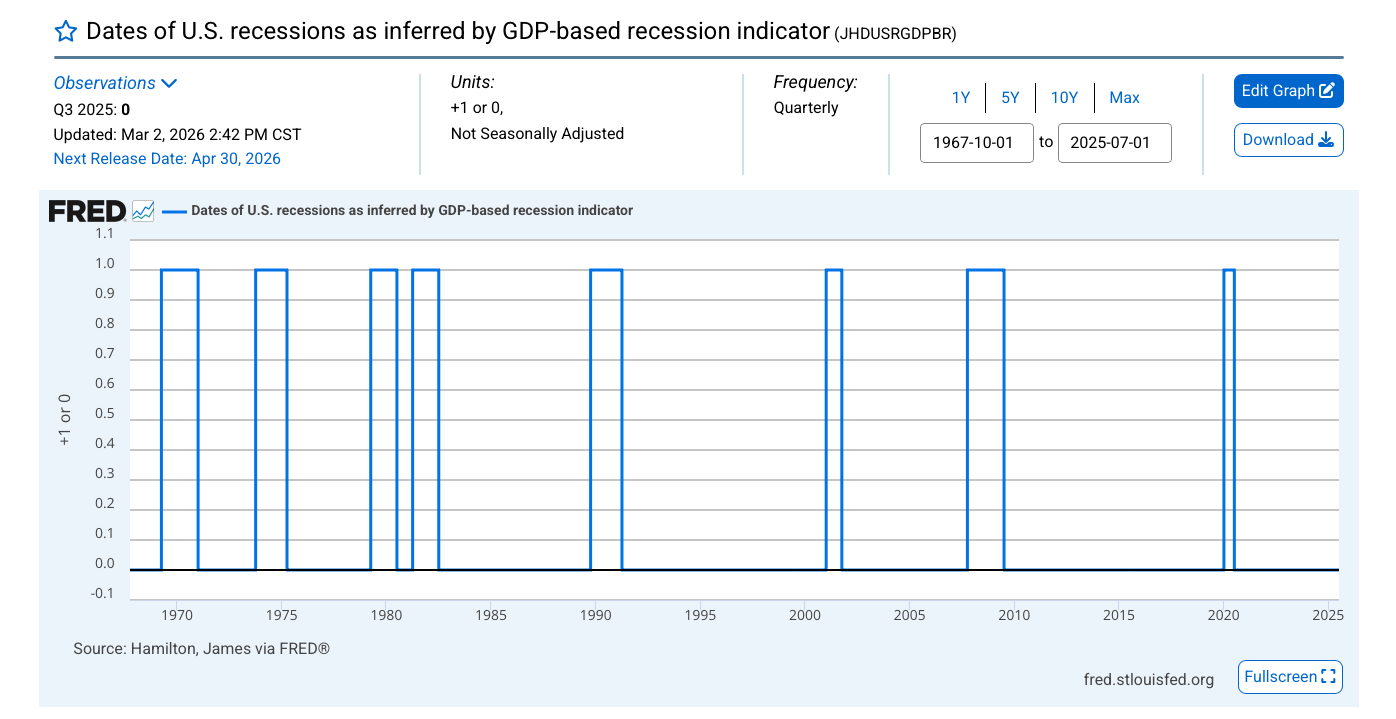
The Moody’s chief economist said his peers “will be loath to utter the word ‘recession,’” despite evidence to support such a statement, because many were proven wrong when they called a downturn calls over Fed policy a couple of years ago. But Zandi added: “If oil prices remain elevated for much longer (weeks and not months), a recession will be difficult to avoid.”
Happier odds
Some investors feel significantly more optimistic about the probability of a recession. Indeed, while economists generally go by the rule that a recession might happen once every five years, if not more frequently, Apollo Investment’s chief economist Torsten Slok suggests economic downturns are becoming less frequent.
“Between recessions, investors should prepare for sector-specific cycles, such as the current downturn in software, where one or two subsectors face distress while the rest of the economy is fine,” Slok wrote in a note published yesterday. “The bottom line is that credit opportunities arise not just during recessions, but also when there are sector-specific cycles during expansions.”
Oxford Economics’ latest Global Risk Survey is similarly more buoyant. The survey, conducted between February 26 and March 11, found there had been a sharp downturn of expectations since the outbreak of the conflict. However, odds of a global recession still stand at a 1-in-6 chance.
The war has driven scepticism over the prospects of the U.S. economy, Oxford notes. Prior to the military action, three-quarters of respondents felt the recent period of U.S. exceptionalism would continue, but that figure fell significantly as the conflict continued, with little more than half the 174 clients surveyed now expecting the U.S. to remain the fastest-growing G7 economy this year.
Indeed, Wall Street is more widely inclined to agree with lower recession odds. David Mericle of Goldman Sachs wrote this week that the bank’s outlook odds had increased, up by 5 percentage points to 25%, while JP Morgan predicted at the end of last year that the likelihood of a 2026 recession was 35%.

