




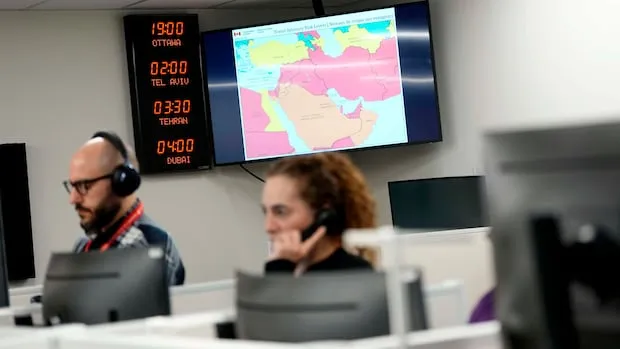

Nova Scotians are among roughly 2,000 Canadians seeking assistance to return home after widespread airspace closures in the Middle East due to escalating conflict involving the U.S., Israel, and Iran. Qatar faces retaliatory strikes from Iran, leaving travelers in limbo.
Halifax Student’s Ordeal in Doha
Maryam Kareem, a 27-year-old nursing student from Halifax, arrived in Doha with her mother on Friday. They planned to fly to Iraq to visit Kareem’s grandmother, who recently suffered a stroke. However, airspace shut down over Qatar on Saturday, prompting multiple shelter-in-place alerts from local authorities.
“It feels lonely, I would say, scary too. I’m sure I’m not the only one, and when I speak, I’m not just speaking for myself. I know many other Canadians are in the same situation and facing the same uncertainty,” Kareem stated.
She and her mother hold return flights to Canada scheduled for March 18, but uncertainty looms. “We’re uncertain if that’s going to be open by then or the airspace is going to be open by then. And by the looks of it, it looks like it’s getting worse,” she added.
Since Saturday, constant strikes have rattled the area, with most intercepted. “It wakes you up from sleep. You feel the whole building shake even if the missiles are intercepted in the sky. You feel the windows shake. It’s very uncertain; we don’t know if some of them have fallen,” Kareem described.
Kareem immediately contacted the Canadian embassy, which advised sheltering in place and following local guidance. Supermarkets and essential services in Doha operate around the clock to ensure access to necessities.
Longtime Doha Resident Seeks Exit
Amanda Williams, originally from Neil’s Harbour, N.S., has resided in Doha since 1998 with her husband and two teenage children. She describes the shift as surreal in a city long known for its safety.
“Qatar has always been a place where it has been a pinnacle of safety and a very calm, moderate life. You can leave your doors unlocked, you can leave your purse on a restaurant table. It’s that safe here,” Williams said. “So come Saturday morning, to start receiving emergency alerts one after the other notifying us of ballistic attacks and drone attacks—it didn’t seem real.”
Despite the tension, residents continue daily activities amid an “air of suspense.” Williams credits Qatari authorities for prioritizing safety, noting most explosions stem from interceptions.
She plans to drive to Saudi Arabia and fly out, but her passport renewal is delayed at the Canadian embassy, which operates remotely. “I’m really not asking them for any assistance; I’m just asking for my document,” she noted.
Evacuation Options for Canadians
Foreign Affairs Minister Anita Anand outlined three primary evacuation strategies: chartered flights, blocked bookings, and land transport, tailored to each region’s conditions such as open airspace or viable land routes.
Qatar Airways organizes bus service for about 200 Canadians holding tickets to reach a Saudi Arabian airport for departure flights.

