




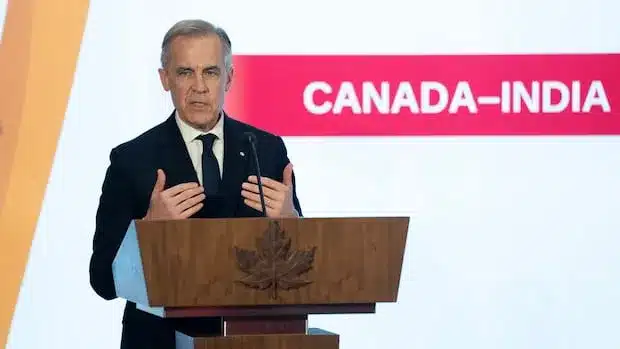

Prime Minister Mark Carney continues his outreach to India, describing the nation as a “natural partner” during a speech to business leaders at Mumbai’s Taj Mahal Hotel. He outlined plans for a comprehensive economic partnership agreement by the end of the year, potentially finalized at the G20 summit in Miami in mid-December.
Previous negotiations focused on sectoral deals for specific products and industries. Now, Carney and Indian Prime Minister Narendra Modi pursue a full free trade agreement amid global trade disruptions from U.S. President Donald Trump’s policies. The leaders meet in Delhi on Monday to sign memorandums of understanding, including a potential supply of Canadian uranium for India’s nuclear program, and launch the final phase of talks.
Business Momentum Builds
Carney’s Mumbai meetings yield positive results, signaling readiness to advance beyond past tensions. He met the chairman of Tata Sons, India’s largest conglomerate with interests in autos, steel, tea, power, and Canadian operations. Efforts aim to attract more foreign direct investment, which reached its highest level since 2007 last year.
Canada also facilitates an agreement between Universities Canada and 13 Indian institutions for enhanced research, student exchanges, and hybrid campuses.
Education Ties Strengthen
Gabriel Miller, president and CEO of Universities Canada, emphasizes quality over quantity in international education. “The first thing is Canada’s focus on international education needs to be on quality, not quantity. There’s no question that the country lost its way there for a couple of years. We were too focused on volume and people were allowed to abuse our system,” Miller stated.
The new pact fosters balance, including faculty exchanges and collaborations in technology and AI. Miller expresses optimism: “I didn’t know what I was going to find when I came here. I think if we stay on the road we’re on, we’ll be able to turn the page and the opportunities here are extraordinary.”
Addressing Past Challenges
Relations faced strains after allegations of Indian involvement in the killing of a Canadian Sikh and other violent incidents. Carney describes his visit as “the end of a challenging period, and more importantly, the beginning of a new, more ambitious partnership between two confident and complementary nations.”
“Canada and India are natural partners,” he told attendees at the Canada-India Growth and Investment Forum. “The reality is, on the economic side, that level of activity is nowhere near our potential, especially as Canada and India both embark on ambitious transformations. We should aim much higher.”
Ongoing Concerns Persist
Sikh community leaders criticize the trip as appeasement amid unresolved questions about the killing of Hardeep Singh Nijjar, which India denies. Foreign Affairs Minister Anita Anand declines to confirm if Indian agents continue foreign interference.
“Foreign interference, transnational repression is taken extremely seriously by our government and it will continue to be taken seriously because no country has a pass when it comes to domestic public safety,” Anand affirmed. She commits to raising Sikh concerns with Indian counterparts: “In order to make progress, you need to be at the table.”
A government official notes Carney prioritizes key issues but remains open to unexpected agreements, as seen in recent talks with China’s Xi Jinping.

