




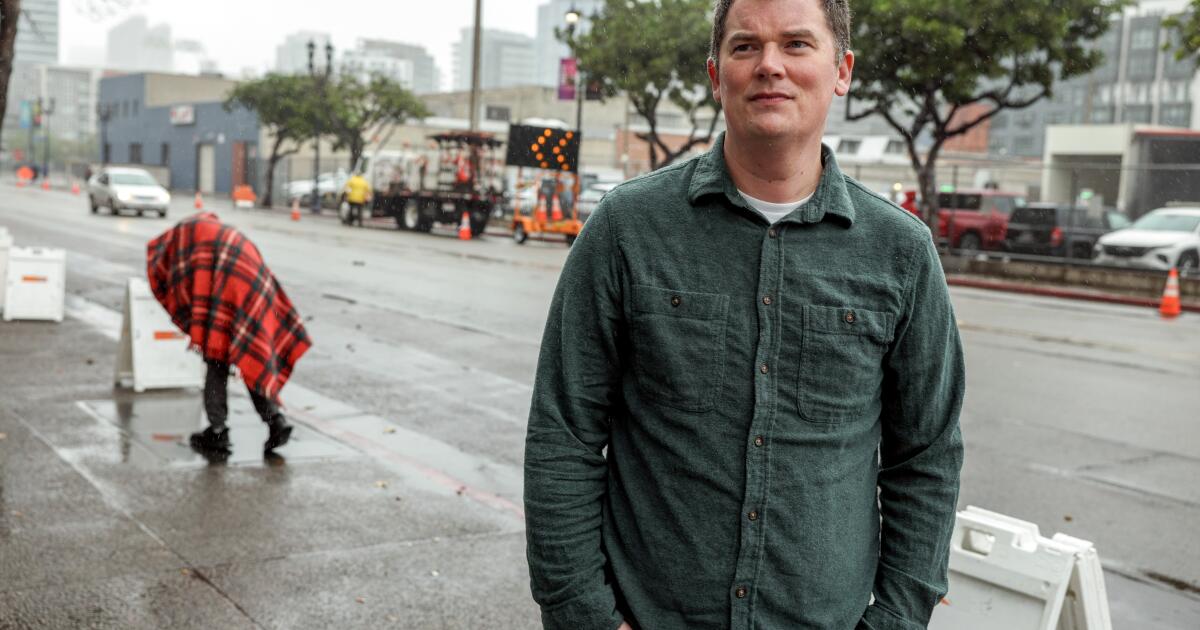

SAN DIEGO — Light rain slicked the pavement in San Diego’s East Village neighborhood on a recent morning, forcing some homeless people to scatter while others huddled under tents or slept through the drizzle.
I was on foot with Dr. Aaron Meyer, a psychiatrist frustrated by California’s most visible crisis: The failure to provide help for many of the people who need it most, despite all the programs rolled out over the years, and all the billions of dollars spent.
We see them in parks, on sidewalks and in other public spaces in obvious distress, and we’ve heard the never-ending conversations and political promises of better days. The problem goes well beyond homelessness: Thousands of severely ill people live with exasperated family members who wear themselves out trying to get help for loved ones.
“We have a history of services that have ended up prioritizing less severe people rather than the most severe,” said Meyer, a UC San Diego associate clinical professor of psychiatry who was speaking on his own behalf, not as a university rep.
In searching for answers, Meyer teamed with lawyer Ann Marie Council, a former San Diego deputy city attorney who once worked in drug court. She was struck by the number of clients spun through the system countless times without getting treatment for addiction or mental illness.
“I was really sick and tired of watching people go to jail when they weren’t getting the help they needed,” said Council, who retired from public service and started Quarter Turn Strategies, a nonprofit focused on practical solutions to fractured public services.
It turns out the doctor and the lawyer make a pretty good team. In their research, they came upon a tool that could address chronic severe mental illness and addiction, and it was hiding in plain sight: in a book of California statutes, namely Section 5200 of the California Welfare and Institutions Code.
The state law governing involuntary commitments and conservatorships for people with severe mental illness is known as the Lanterman-Petris-Short Act, and it includes the commonly used Section 5150 for those deemed “gravely disabled.” The process begins with a 72-hour hold that can lead to a longer commitment, but often does not.
Section 5200 outlines a far more thorough evaluation and care plan than 5150. The 5200 process can be initiated by anybody concerned about someone who is gravely disabled or a danger to themselves or others (with misdemeanor penalties for abuse of the reporting privilege).
Dr. Susan Partovi, who has practiced street medicine in Los Angeles for many years, has a term for the 72-hour hold under 5150:
“We call it the 72-second hold,” she said.
I’ve written previously about Partovi’s moral outrage over the number of severely ill people who either are not deemed “gravely disabled” or who spin repeatedly through three-day holds and return to the same self-destructive routines. I’ve also heard her talk about who among her clients is likely to die next.
Partovi is a member of Grave Disability Workgroup of California, which has endorsed a research paper on 5200, “The Lost Legal Pathway to Mental Health Care,” co-written by Meyer and Council and released a few weeks ago by Quarter Turn. It detailed the frustrations of families, outreach workers and first responders and concluded that 5200 could help break down some of the bureaucratic barriers to life-changing mental health care.
In San Diego, as Meyer and I passed a woman trying to erect a tent in the rain and a person asleep on a littered patch of weeds, I asked him to explain the difference between 5150 and 5200.
Under a 5150 commitment, he said, a person is often brought to an emergency room for an assessment by someone who is not necessarily a behavioral health specialist. A decision is then made about whether the person meets the legal criteria for an involuntary hold.
“If they don’t, then they’re released, and there’s no requirement for any care coordination,” Meyer said. Under 5200, a full medical evaluation is required with a multidisciplinary team, “and it also requires a coordinated care plan on discharge,” raising “the hope of leading to something substantive.”
In their research, Meyer and Council found that 5200 is not known to be in use in any of the state’s 58 counties, with public officials either unaware of it or under the impression that it’s an unnecessary tool given other initiatives over the decades, and cost of implementation could be a problem.
Meyer argues that the state spends billions without addressing glaring needs, and 5200 could cost less than roller-coastering people through hospitals, courts, jails and prisons without putting them on a healthier track.
Meyer said he’s gotten pushback from civil libertarians and disability rights groups, both of which have long opposed coerced treatment and argued instead for a host of greater resources in housing and preventive healthcare, and for more outreach that can lead to voluntary treatment.
I understand the pitfalls of forced treatment, having been on a 20-year journey with someone who initially resisted help and objected to medication. It’s true that forced treatment doesn’t always get the desired outcome, and can backfire if it makes the person more resistant to treatment.
But some people can become too sick to make a decision in their own best interest, which is why we’ve seen so many of them at death’s door, living in squalor and desperation, tortured by psychosis or chewed up by killer drugs.
Care Courts, which were meant to help address this, have not yet had the anticipated impact, and some families have felt let down. Meyer and Council say that although those courts can implement 5200, that isn’t happening yet.
The fact that 5200 is little known and never used “is another example of systems failure,” said former state senator and Sacramento Mayor Darrell Steinberg.
Steinberg said although 5200 isn’t a one-step answer to homelessness or untreated severe mental and addiction illness, it’s worth implementing given the existing “set of systems that are not responsive to people who are the sickest of the sick.”
Jon Sherin, former head of L.A. County’s mental health department, called 5200 “one of the most powerful tools” available and said he tried to implement it several years ago but faced some of the same resistance described by Meyer.
“If you used it thoughtfully and had capacity, you could actually have a massive impact,” said Sherin, who urged those running for governor to “bring 5200 into the limelight and guarantee resources to counties.”
The same can be said about the race for Los Angeles mayor. Despite some progress, homelessness is still a public catastrophe, and gravely ill people are a haunting representation of policy failures.
Supporters of 5200 include Bay Area resident Teresa Pasquini, a mental health reform advocate whose brother and son have both dealt with severe mental illness. Pasquini, whose causes include “Moms on a Mission” and “Housing that Heals,” told me her son, now in his 40s, has been through the 5150 turnstile 40 times.
Pasquini said people in her circumstances have been accused of wanting to shed their troubles by having their kids locked away. All she really wants, she said, is for him to be housed and safe and given proper care.
“We need all the tools we can get … and we need 5200,” Pasquini said. “I’ve watched my son walk out the front door in handcuffs over 40 times. Treatment is not a bad word.”
steve.lopez@latimes.com

