




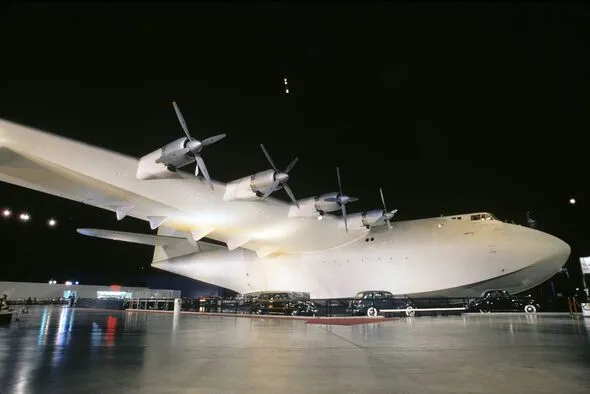

The Hughes H-4 Hercules, famously nicknamed the Spruce Goose, holds the title of the world’s largest flying boat. Its enormous 320-foot wingspan surpasses the length of many football pitches, which typically measure 300 to 390 feet.
Design and Intended Purpose
Engineers at Hughes Aircraft Company constructed this massive prototype for transatlantic transport during World War II. The flying boat aimed to carry up to 750 troops or heavy cargo like two Sherman tanks across the ocean. Its fuselage extends over 218 feet, with an empty weight approaching 113,400 kg. The structure relies primarily on laminated birch wood.
Eight powerful engines drive the aircraft, each equipped with four-bladed propellers spanning 17 feet in diameter. Four engines mount on each side of the fuselage, supporting the staggering wingspan.
The Historic Single Flight
The prototype missed wartime deployment and advanced only to a single test flight. On November 2, 1947, aviator Howard Hughes piloted it from Long Beach Harbor in California. The aircraft lifted off, soared about 70 feet above the water for roughly 26 seconds, and covered approximately one mile before splashing down.
Legacy and Display
The Spruce Goose never progressed beyond this prototype stage, evolving into an aviation legend. For decades, it claimed the record for the widest wingspan among aircraft until the Stratolaunch jet’s 385-foot span debuted in 2019.
Today, visitors explore its immense scale at the Evergreen Aviation & Space Museum in McMinnville, Oregon.

