



A recent survey indicates that 90% of Canadians support establishing a minimum age for social media access, alongside creating a regulator to oversee tech platforms. Advocates press Prime Minister Mark Carney’s government to prioritize online safety measures as it reviews potential solutions.
Key Poll Results
The Leger poll, commissioned by the Safer Online Spaces Coalition—including the Amanda Todd Legacy Society—surveyed 1,502 Canadians online from January 26 to 29. Respondents overwhelmingly favored age restrictions on platforms, with 27% suggesting 14 to 15 years and another 27% proposing 16 to 17 years.
Around 53% backed stronger regulations for social media companies, even amid pressures from U.S. President Donald Trump, particularly among women and older adults. An additional 27% supported it depending on circumstances.
Major concerns include child addiction to social media (73%), false information and fraudulent ads targeting minors (76%), and online sexual exploitation (74%). Additionally, 90% hold tech companies accountable for child-facing content, 79% favor a dedicated regulator, and 77% endorse stricter enforcement, including for AI tools.
Online polls lack traditional margins of error, but for comparison, a probability sample of this size carries a ±2.5% margin, 19 times out of 20.
Advocates Demand Urgent Action
“As a parent, as an educator, as a human in Canada, I’m very frustrated,” said Carol Todd, founder of the non-profit honoring her daughter Amanda Todd, whose 2012 death highlighted online sextortion risks. She noted challenges in monitoring and enforcing age bans.
“It is actually breathtaking as a pediatrician to see the online environment remain an unregulated space,” stated Dr. Charlotte Moore Hepburn, director of child health policy at The Hospital for Sick Children in Toronto. She described digital exposure for developing minds as “the largest, fully unregulated clinical trial affecting human development in the history of civilization,” linking it to anxiety, depression, self-harm, and eating disorders.
“Government has experience wrapping its arms around previously unregulated industries,” Moore Hepburn added. “Government has the capacity to do this if the political will is there.”
Government Response and Global Context
The government pursues Criminal Code updates, such as criminalizing AI-generated sexualized “deepfakes.” Advocates push for broader regulations, reviving prior proposals for a regulator and ombudsperson.
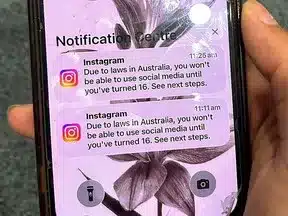
Officials examine approaches from other nations. Australia bans platforms like Snapchat, Facebook, TikTok, and Instagram for those under 16. The UK and Germany consider similar measures, while France enacted a ban for under-15s.
French President Emmanuel Macron, speaking at an AI conference in New Delhi, dismissed the Trump administration’s free speech arguments against regulation as “pure bullshit,” criticizing opaque algorithms.
“We all want our children to be safe as they navigate the digital world, and platforms have an important role to play in meeting that challenge,” said Hermine Landry, spokeswoman for Minister of Canadian Identity and Culture Marc Miller. “Our government intends to act swiftly to better protect Canadians, especially children, from online harm. No decisions have been made and we will have more details to share in due course.”
Todd expressed frustration over unclear timelines: “Is it going to be a year? Is it going to be two months? What’s it going to look like? Like, they’re not even feeding us little tidbits, right, so it gets really frustrating.”
Moore Hepburn added, “We are heartened by the increasing interest the federal government has showed. However, time is of the essence and urgent action is required.”

