





Scientists have uncovered the world’s oldest fossilized predator vomit, dating back nearly 290 million years. This remarkable find from the Bromacker excavation site in Germany sheds light on feeding behaviors in early land ecosystems, long before dinosaurs appeared.
Key Findings from the Study
The fossil, classified as regurgitalite, marks the earliest confirmed example from a fully terrestrial environment. Detailed in a recent Scientific Reports publication, it preserves undigested remains expelled by a predator.
Mark MacDougall, a paleontologist and assistant professor at Brandon University in Manitoba, co-authored the research. “This fossil is extremely important for understanding how early land ecosystems worked,” MacDougall stated. “It’s rare to get such direct evidence of who was eating whom nearly 300 million years ago. In this case, the predator clearly bit off more than it could stomach.”
Advanced Analysis Uncovers Prey Remains
CT scans and chemical analysis revealed bones from at least three distinct animals within the cluster: a small reptile, a fast-moving lizard-like creature, and part of a larger herbivore. Unlike fossilized feces (coprolites), regurgitalites retain partially intact skeletons not fully broken down by digestion.
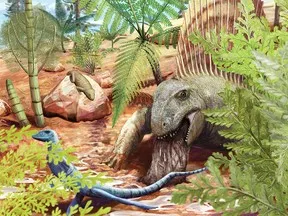
Evidence points to a large predator, possibly an early mammal relative like the sail-backed Dimetrodon, which predated dinosaurs by about 40 million years. “These animals lived together, died together, and ended up in the same regurgitated pile, probably within days of each other,” MacDougall noted. “That kind of detail is incredibly rare in the fossil record.”
Ecological Insights and Study Leadership
The discovery provides the first direct proof of opportunistic feeding by a terrestrial predator. Researchers from Germany’s Museum für Naturkunde in Berlin and France’s CNRS led the effort, with Brandon University contributing key interpretations of the fossil’s ecological role.
Modern parallels exist in predators like owls and wolves that regurgitate indigestible parts, but such ancient evidence is exceptional. The find illuminates predator-prey dynamics in prehistoric land communities.

