



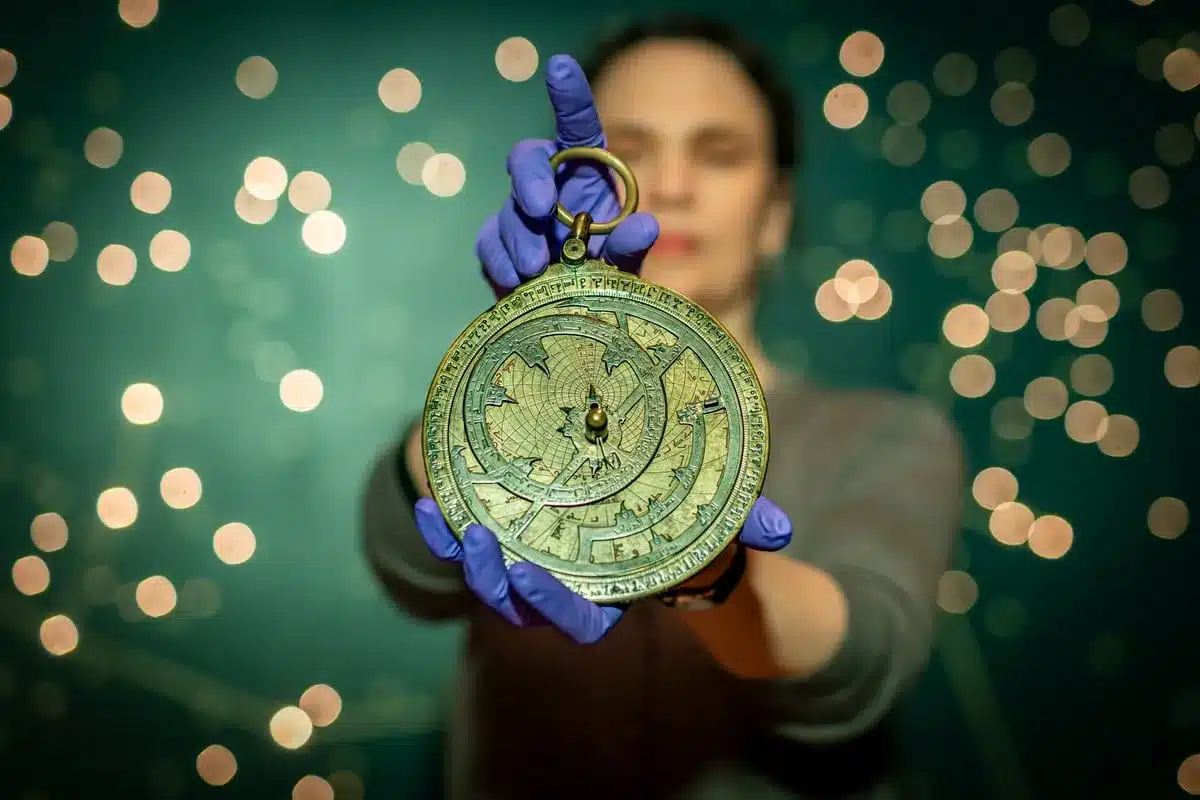

A remarkable brass astrolabe in Scotland has reached 1,000 years old, standing as one of the oldest signed and dated examples surviving in Europe. Crafted in 11th-century Spain, this intricate instrument belongs to National Museums Scotland’s collection and recently returned after a loan to the British Museum.
Unexpected Discovery in a Second-Hand Shop
Collector James H. Farr acquired the astrolabe in a second-hand shop on Edinburgh’s Lawnmarket. Farr, who operated Wardie Garage on Ferry Road, donated it to the museum in 1959. A diverse collector of military memorabilia, locomotives, automobiles, and more, he also served as Secretary of the Edinburgh Society of Model Engineers. In a 1960 interview, Farr revealed his purchase from the Edinburgh shop.
Crafted by a Master in Cordoba
Muhammad ibn al-Saffar created the astrolabe in Cordoba, dating it to 417 AH in the Islamic calendar, equivalent to 1026-1027 AD. Astrolabes served as versatile tools for observing and calculating celestial positions, enabling timekeeping, navigation, astronomy, and astrology. These devices demonstrate how ancient scholars charted the cosmos well before telescopes emerged.
Historical Significance and Display
Researchers highlight the astrolabe as one of Scotland’s rarest and most significant artifacts, offering insights into a millennium of astronomical advancements. Dr. Rebekah Higgitt, Principal Curator of Science at National Museums Scotland, states: “As this incredible object turns 1,000 years old, we reflect on how a single object can connect science, history and culture. It reveals to us how early scholars observed the stars and helps us understand how past learning has helped shape the modern world. We are privileged to share this story with our visitors as we mark this remarkable milestone.”
Visitors can view the astrolabe on permanent display in the Earth in Space gallery on Level 1 at the National Museum of Scotland in Edinburgh.

